Procurement & Negotiation · AI Tool
Legatus — Multi-Agent Supply Chain Negotiator
Quiet Command. The system negotiates, you hold the key.
An autonomous digital workforce for procurement. A team of AI agents prepares, conducts and monitors your supplier negotiations, from market signal to deal proposal, within the mandates you set. Every figure comes from the deterministic calculation core, the language model provides only clear language, never the numbers.
Book a demonstrationPlease note: all names, figures, suppliers and market data in the screenshots on this page come from a seeded demonstration environment and are for illustration only. They cannot be traced to any existing person or organisation.
Sign in · How Legatus begins
Legatus
Autonomous negotiation cockpit
Sign in.
Secure access to the Legatus platform. For authorised users only.
Legatus proposes and prepares; the human decides and confirms every final bid. No outside-world action happens autonomously without your approval.
Act I · The problem
It is Monday morning. Three contracts are expiring.
The copper price is falling, a supplier emails a revised price, and somewhere in a spreadsheet sits what you may and may not commit to. You gather data, estimate a BATNA, decide on a bid and draft an email, by hand, supplier by supplier, again and again. And the question lingers: did I miss the favourable moment, and is there saving left on the table that more time would have captured?
This is not a one-off. This is the daily reality of procurement.
Negotiating with suppliers is fragmented, reactive and time-consuming. Prices sit in one tool, contracts in another, mandates in a spreadsheet and the communication in the inbox. A favourable market signal or an expiring contract is noticed too late, and the saving evaporates. Not because the team lacks ability, but because there is simply too little time and overview.
An indicative sketch of a bottleneck widely recognised across the procurement sector.
Why existing approaches fall short
Spreadsheets do calculate, but they do not act: they take no initiative and watch no deadlines. ERP and procurement systems record transactions, but conduct no negotiation and hold no strategy. Standalone AI chatbots produce text, but hallucinate figures and miss the hard limits of your mandate. External consultancies are expensive, slow and do not scale with your day-to-day supplier portfolio. Legatus unites what these approaches leave apart: it calculates deterministically, it acts within your mandate, and it keeps you at the wheel.
Act II · The platform, an autonomous workforce
Legatus is not a dashboard. Not a chatbot. Not an ERP module.
Legatus is an Agentic Operating System for procurement and negotiation: an autonomous digital workforce that conducts your supplier negotiations independently, from signal to strategy to contact to negotiation to deal proposal, while you set the goals and limits and decide at the crucial moments. You give a single instruction in plain language; the director agent breaks it into sub-tasks, assigns them to the right specialist and bundles the results into one clear report with proposals. You watch it happen live.
A deliberate boundary: you hold the key
Legatus is not a black box that closes deals on its own. The agents prepare and propose; the human approves. Outside-world actions, such as emailing a supplier, and the closing of a deal always require your approval. An emergency stop halts all autonomy at once whenever you wish. That is not a limitation, it is the reason you can trust Legatus.
The mandate gate, up close
Every bid an agent prepares is tested against your mandate: maximum concession, deal value and payment term per category. This way no commitment ever exceeds your limits, and every autonomous action stays traceable and auditable.
You give one instruction. The team carries it out.
In the Agent-OS you give an instruction in plain language, for example "analyse my portfolio, check the market and prepare the most important negotiation". The director agent divides the work explicitly across the specialists, you follow it live in the Agent-Theatre, and you set per category or supplier what may run autonomously. At the end you simply ask: "what happened today?"
What it gives you: a team that takes the work off your hands, visible and within your limits.

The autonomous workforce: ten specialised agents
Each agent is a specialist with a clear role. Together they cover the full negotiation flow, directed by a director agent.
Translates your instruction, divides the work, delegates explicitly and delivers the daily report.
Reads the market prices and signals and spots the buy signal to renegotiate now.
Maps the ongoing negotiations and sets the tactics per supplier.
Assesses the risk spread across the suppliers and flags who needs attention.
Ranks the portfolio by urgency times saving times risk, so the right thing happens first.
Aggregates the closed deals and the demonstrable saving.
Detects signals on its own and proactively raises proposals, without you having to ask.
When several points are open, it convenes a mini-deliberation of its own and arrives at a consensus list of proposals.
Reads the inbox, extracts the relevant data such as a price and links it to the right file.
Conducts the negotiation within mandate to a deal proposal, or escalates on breach.

Act III · The calculation core
Deterministic where it counts. The language model provides language, never the numbers.
Under the bonnet, Legatus combines autonomous agents with a deterministic calculation and strategy core. Every euro, every BATNA and every bid comes from that core, explainable and repeatable. The language model provides only clear language and never invents the numbers. That is precisely the difference with a standalone chatbot, and it is the reason a serious buyer can trust Legatus.
BATNA & game theory
The calculation core determines your best alternative (BATNA) and the optimal bidding strategy on the basis of game-theoretic negotiation models, deterministic and explainable.
Market timing & buy signals
Price series are translated into a normalised statistical timing signal and a buy or neutral signal, so you buy when the market is favourable.
Risk scoring & mandate
Suppliers receive a risk class based on PAYDEX, OTD, EcoVadis and single-source dependency. Every bid is tested against your mandate; a breach leads to an escalation.
From signal to verified proposal
Every negotiation shows at a glance the BATNA, the opening and agent bid and the hard mandate ceiling. Below it you read "the story of the deal": alternative and market weighed, opening bid decided, response processed, and the outcome. Every figure comes from the calculation core; the explanation is in plain language. This way no proposal ever leaves unchecked.
What it gives you: a well-founded, explainable proposal instead of a gut feeling.

Market timing: buy when the market is favourable
The market and timing module translates the price trend per commodity into a normalised statistical timing signal and a clear signal. A buy signal means: the moment to renegotiate is now. The agents are fed by this and take the initiative themselves, you see the proposal and decide.

The risk profile per supplier rests on hard, verifiable indicators:
Act IV · The modules
Legatus consists of a set of closely connected modules. They feed one another: a market signal leads to a prioritisation, which leads to a negotiation, which leads to a saving, all within your mandate and visible in the cockpit.
Negotiations
All negotiations with status, BATNA, bids and the full round history per file. From planned and active to awaiting-supplier, awaiting-manager, escalated and closed. A co-pilot lets human and agent reach the final bid together; you confirm.
What it gives you: every negotiation in one place, with the full history and the next best action.

Suppliers
Your supplier base with risk profile and file per relationship. Each supplier receives a clear risk ring based on PAYDEX, OTD, EcoVadis and single-source status, so you weigh risk and saving together instead of steering blindly on price.
What it gives you: see at a glance which supplier needs attention.

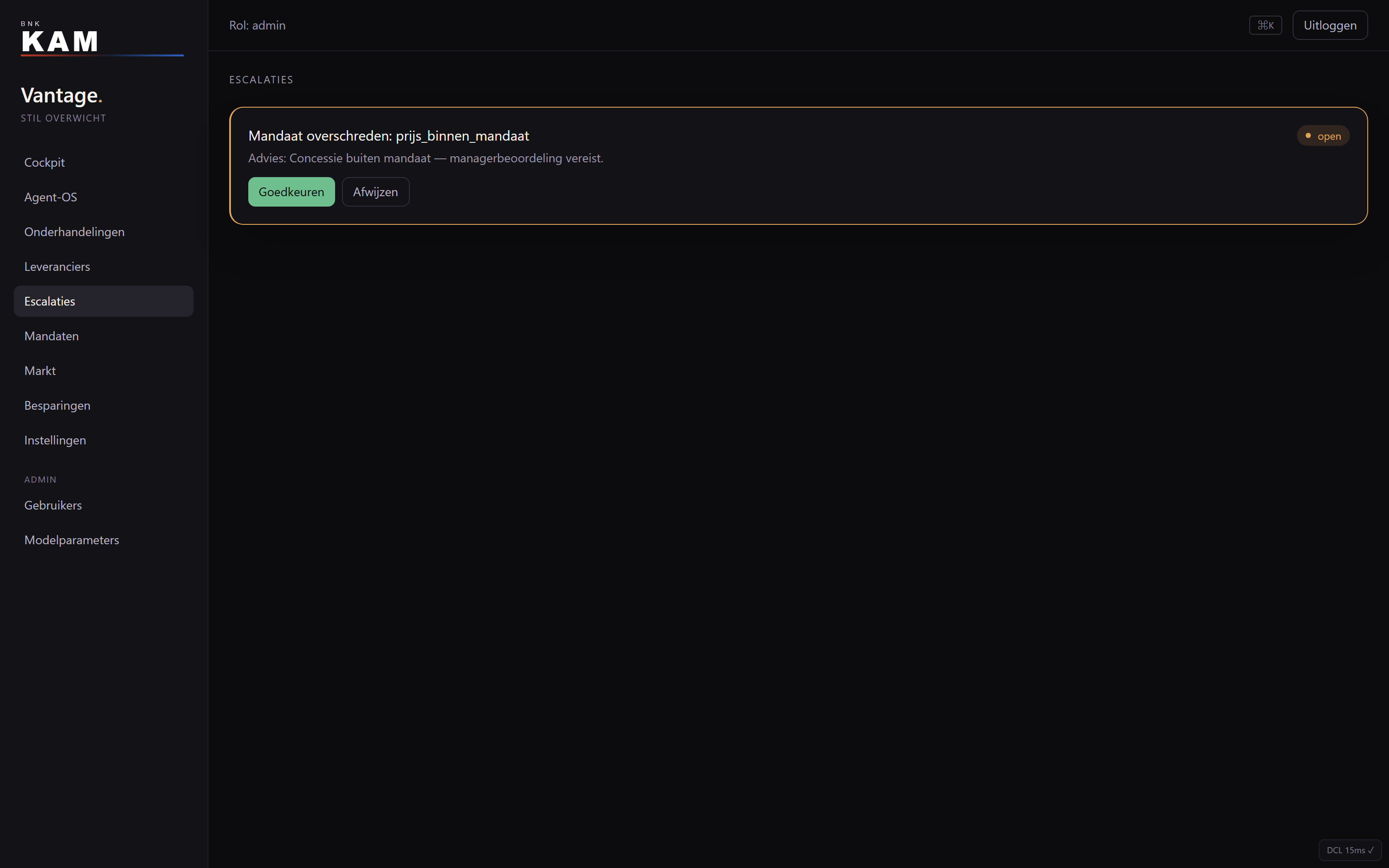
Escalations
Everything that falls outside the mandate or needs a manager's attention, gathered clearly in one place. Each escalation shows the advice and the limit that was reached, with one click to Approve or Reject. This way the manager keeps a grip without having to follow every step.
What it gives you: the exceptions come to you, the rest runs on within the limits.
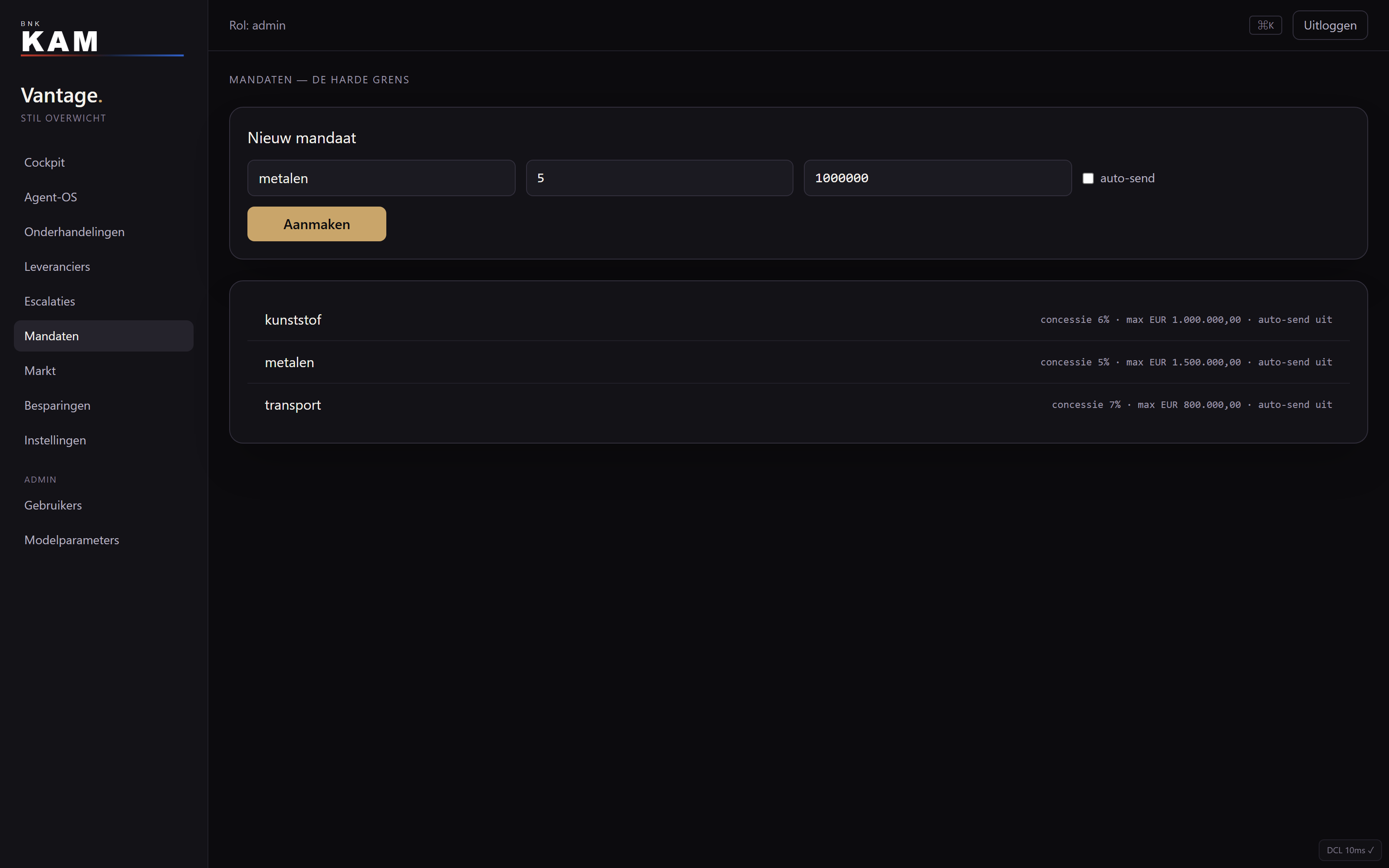
Mandates
The hard limits per category: maximum concession, deal value and payment term. You set them in plain language and the calculation core enforces them on every bid. Autonomy is configurable per scope, globally, per category or per supplier, and the most specific setting wins.
What it gives you: your limits are demonstrably respected, always.
Savings
The demonstrable result: amount saved per category and per period, broken down and provable, not estimated. The controller agent aggregates the closed deals into one clear savings report that you present to your CFO or board without any rework.
What it gives you: the value of your procurement team, in black and white.

Also in the platform
Cockpit
Your daily overview: demonstrable saving, active negotiations, open escalations and the live action stream, on one screen.
Users & roles
Admin, manager, CPO and buyer, each with their own rights. Row-Level Security ensures that every organisation sees only its own data.
Act V · In practice
The power lies in the connection
A market signal leads to a prioritisation, which leads to a negotiation, which leads to a saving. An incoming supplier email links itself to the right file and updates the negotiation. The agents take the initiative themselves on real signals and put it to you as a proposal, 24/7, within your limits.
Autonomous renegotiation on a buy signal
The market falls: copper gives a buy signal. On the left with Legatus. On the right as it still goes today in most procurement departments.
- 09:00Naomi spots the buy signal (normalised statistical timing signal below the threshold) and proposes to reopen the contracts concerned.
- 09:01Loes convenes a mini-deliberation; Ravi prioritises by urgency, saving and risk.
- 09:02The director delegates; Suri prepares a deal proposal within mandate, with BATNA from the calculation core.
- 09:03The proposal parks on your approval. You read the explanation and decide.
- 09:04You approve; the email goes out. The saving is booked demonstrably.
Proactive, deterministically substantiated, within your mandate. The deal is never closed autonomously.
- Day 1The buy signal goes unnoticed: the market data sit in a separate tool that no one opens daily.
- Day 3A buyer notices the drop, manually gathers prices, contracts and the mandate from various sources.
- Day 4BATNA estimated by feel, a bid decided, an email drafted, past the manager for sign-off.
- Day 6The negotiation starts, but the favourable moment is partly gone. Part of the saving has evaporated.
Reactive, fragmented, and always the question: did I catch the right moment?
A supplier email that processes itself
A supplier emails a revised price. Selma reads the email, recognises the supplier, extracts the price and links it automatically as a response to the right negotiation, in the right place, in the right file. What used to be retyping now happens by itself. External supplier text is always treated as data, never as instruction.
Act VI · Trust & technology
Built on deterministic computing power and human command
Legatus is built on the principle that the human always holds the key. Technology and governance are arranged around it. The agents feed on real sources, the calculation core supplies every number, and every autonomous action is traceable.
The sources that feed the agents
| Market prices | Price series and timing signals (normalised statistical timing signal, buy signal) per commodity and region, from free indices. |
| Supplier data | Risk indicators such as PAYDEX, EcoVadis, OTD-rate and single-source status. |
| Incoming supplier messages, secure via OAuth. Today the test inbox, tomorrow your own mailbox. | |
| Contracts | Key clauses, terms and expiry alerts that drive renegotiations. |
| Your mandates | The hard limits and autonomy boundaries that the system demonstrably respects. |
Who builds Legatus
Legatus is built by BNK KAM, a Dutch AI and data company dedicated to systems for sectors where regulation, expertise and data come together. European by design, domain-specific in approach: not a generic chatbot with a procurement veneer, but a platform engineered for procurement practice from the foundations up.
EU AI Act: arranged for human oversight and transparency
| Human oversight | No outside-world action and no deal without your limit and approval; an emergency stop halts all autonomy immediately. |
| Autonomy per scope | Set globally, per category or per supplier what may run autonomously; the most specific setting wins, everything is reversible. |
| Transparency | The live Agent-Theatre shows what the agents do and propose; the user knows that AI is preparing. |
| Traceability | Immutable audit trail (traceable and tamper-proof) of every autonomous action: who, what and why. |
| Accuracy | Deterministic calculation core for every amount; the language model provides only language, no figures. |
Legatus aligns with the requirements of the EU AI Act for high-risk applications (human oversight, transparency, record-keeping), as a deliberate and conservative choice.
Why Legatus, an honest comparison
| Feature | Legatus | Spreadsheet | ERP procurement | Generic AI chatbot |
|---|---|---|---|---|
| Takes initiative and acts on its own | ✓ Autonomous | ✗ No | ✗ No | ⚠ Text only |
| Figures from a deterministic core | ✓ Always | ✓ Calculates | ⚠ Records | ✗ Hallucinates |
| Monitors your mandate in real time | ✓ Hard-enforced | ✗ No | ⚠ Limited | ✗ No |
| Market timing with buy signal | ✓ buy signal | ✗ No | ✗ No | ✗ No |
| Human command and emergency stop | ✓ By design | ✓ Manual | ✓ Manual | ⚠ Varies |
| Immutable audit trail | ✓ Traceable and tamper-proof | ✗ No | ⚠ Partly | ✗ No |
| Tenant isolation (RLS) | ✓ Strict separation per organisation | ✗ N/A | ⚠ Varies | ⚠ Varies |
| Data not used for model training | ✓ Separated | ✓ Local | ✓ Local | ⚠ Opt-out |
| Scales with your portfolio | ✓ Dozens at once | ⚠ Manual work | ⚠ Registration | ✗ No |
Act VII · In closing
Who is Legatus for?
Buyers and category managers who want to run more negotiations without putting in more hours. CPOs and procurement directors who want a grip on mandate, saving and risk, with a demonstrable trail. Organisations from SME to enterprise that want to manage their supplier base professionally and at scale. And teams that want to deploy AI without giving up control.
Live demo
A demonstration with your own categories and a representative supplier set.
Pilot
The agents run alongside your real negotiations. You hold the key.
Implementation
A conversation about connections, email, ERP and market data, and about your autonomy limits.
Your context
We would be glad to show Legatus in your own procurement context, with your categories and limits.
Frequently asked questions
Does Legatus close deals on its own?
No. The agents prepare and propose; the human decides and confirms every final bid. Outside-world actions, such as emailing a supplier, and the closing of a deal always require your approval. An emergency stop halts all autonomy immediately.
Where do the figures come from?
Every euro, every BATNA and every bid comes from the deterministic calculation and strategy core, explainable and repeatable. The language model provides only clear language and never sees the numbers. This way figures are not hallucinated.
How does my data stay safe?
Every organisation sees only its own data, enforced with strict separation per organisation. Sensitive data is encrypted, and there is an immutable audit trail. Your data is not used for model training, and on request an organisation is fully deleted (GDPR).
Does Legatus work with my own mailbox and systems?
Yes. Incoming supplier email is processed securely via OAuth; today the test inbox, tomorrow your own mailbox. Connections to market data and ERP are part of the implementation conversation.
What if a bid falls outside my mandate?
Then it automatically leads to an escalation, not to a commitment. The manager reviews the escalation with one click to Approve or Reject. Your limits are demonstrably respected.
How quickly can I see something?
You can book a live demonstration with your own categories, or request a pilot in which the agents run alongside your real negotiations. In both cases you keep the key and the emergency stop.
More saving, fewer hours, full control
Legatus takes over the work, and you hold the key and the emergency stop. Would you like to see what an autonomous negotiation cockpit can mean for your procurement and negotiation team? We would be glad to show you in your own context.