Optimisation · AI Tool
Quantum Engine — Hybrid Optimisation
Describe your problem. Get the optimal solution.
A hybrid optimisation platform that combines quantum-inspired and classical algorithms. From route to roster to portfolio, verified and explainable, with the built-in AI assistant KAM and human oversight.
Book a demonstrationPlease note: all names, organisations, amounts and usage data in the screenshots on this page are fictitious and serve for illustration only. They cannot be traced to any existing person or organisation.
Sign in · How the Quantum Engine begins

Optimise
the impossible
Combinatorial optimisation via quantum and classical algorithms. Suitable for realistic route and portfolio sizes, with an upfront cost estimate per problem.
Sign in
Access to the Quantum Optimization Platform.
No account yet? Register
EU AI Act art. 13 compliant, transparent algorithmic decision-making.
Act I · The problem
The best answer drowns in the possibilities
Every organisation that plans routes, rosters staff, distributes stock or assembles a portfolio wrestles with the same question: what is the best choice among an astronomical number of possibilities? A route past twenty stops already has more orderings than there are stars in our galaxy. By hand or in a spreadsheet, the truly best choice can no longer be found.
Why existing approaches fall short
Manual methods and spreadsheets work up to a handful of points, then no longer, with no guarantee of quality. Standalone solvers are powerful but demand specialist knowledge and provide no intelligible justification or measure of quality. Black-box AI gives an answer, but not how certain it is or why, and without human oversight.
That fragmentation costs time, money and CO₂. The Quantum Engine solves it.
Act II · The platform
One platform, from question to verified answer
The Quantum Engine is a web platform for combinatorial optimisation. You submit a problem from a catalogue of more than thirty-six problem types, from routing and scheduling to assignment, allocation, network, financial and energy. A smart router automatically selects the best-fitting algorithm, from classical (OR-Tools, Simulated Annealing) to quantum-inspired (Simulated Bifurcation, QAOA) to hybrid, and delivers a solution with a calibrated quality score and full explanation.
What it gives you: you describe the problem, the platform selects, computes, verifies and explains.
A deliberate boundary: you decide
The Quantum Engine is not a black box and not a replacement for your judgement. It computes, verifies and explains; you decide. Every autonomous action has guardrails, an audit trail and a human in the loop. That is not a limitation, it is the reason you can trust the outcome.
Talk to your problem
Describe your problem in plain language, for example "plan the shortest route past eight shops", and the engine recognises the problem type, proposes parameters and takes you to the right form. Or choose directly from the searchable catalogue of problem cards, each with algorithm badges, maximum problem size and a cost estimate.
What it gives you: from a sentence in plain language to a completed, checkable form.

Every problem family, one swipe away
The catalogue is organised into problem families. Filter by a category and you immediately see which problems the engine can handle within it, each with its own algorithm badges, a maximum problem size and a cost estimate up front. Swipe through the families below, or tap a category. These are real recordings from the running application.
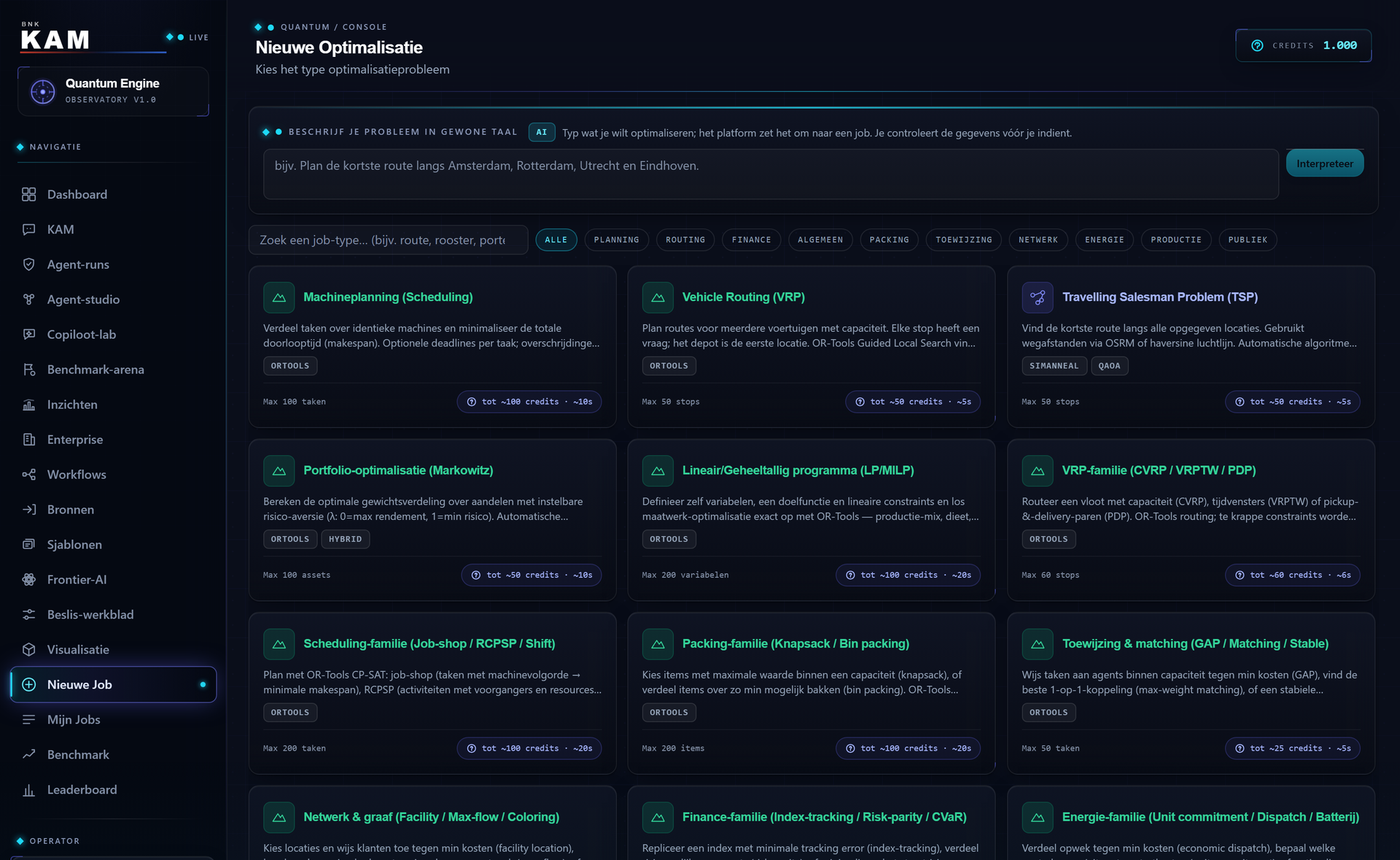


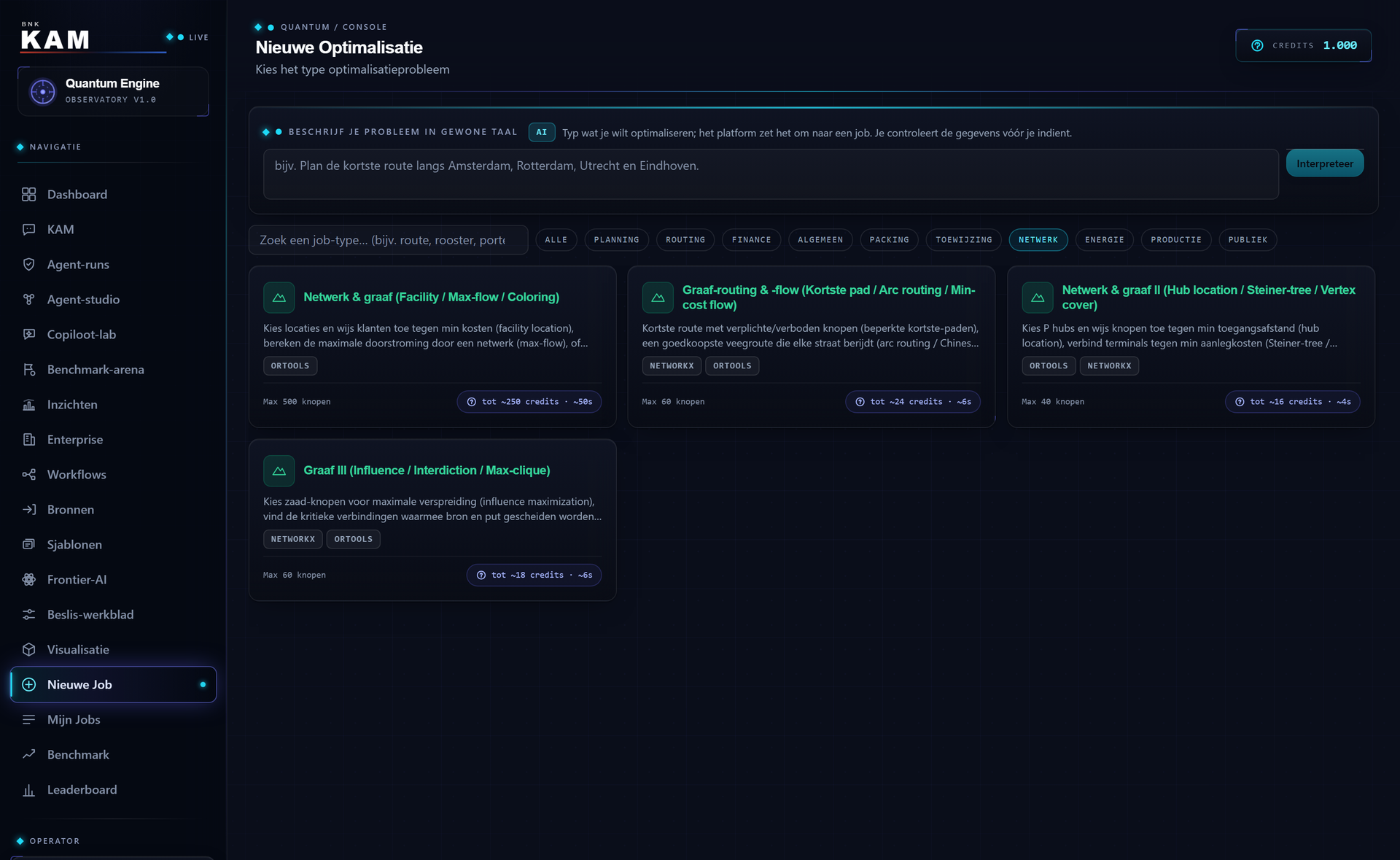


One framework for 36+ problem types
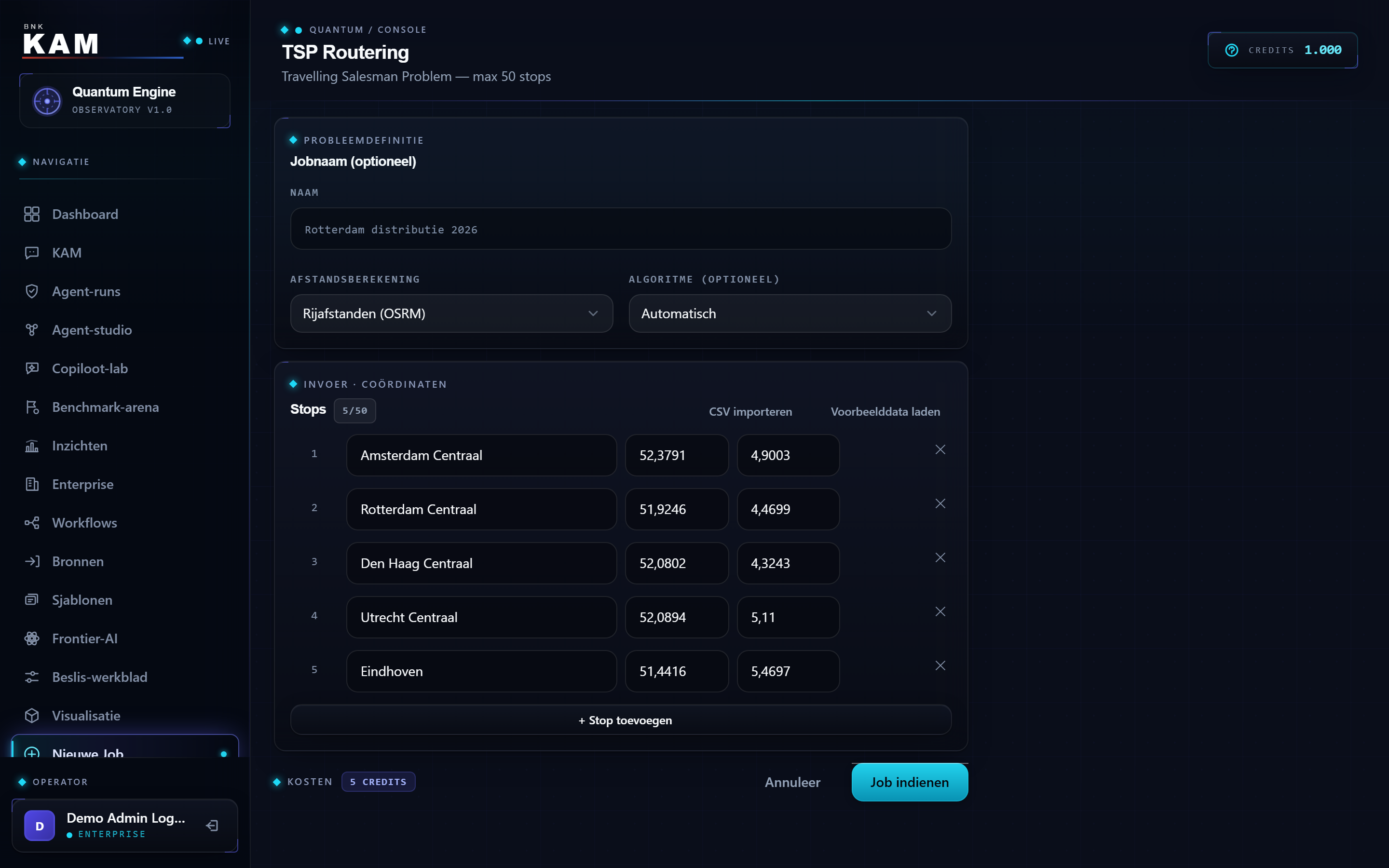
Every problem family shares the same framework: an input card, parameters, an optimise button and a result view. From routing (TSP, VRP, Dial-a-Ride) to scheduling, assignment, packing, network, financial (Markowitz portfolio), energy and supply chain. You choose the variant, enter your data or import a CSV, and submit. You stay at the helm.
What it gives you: one trusted way of working for your entire portfolio of problems.
Act III · KAM, the intelligent core
KAM: not a standalone chatbot, but a layered system
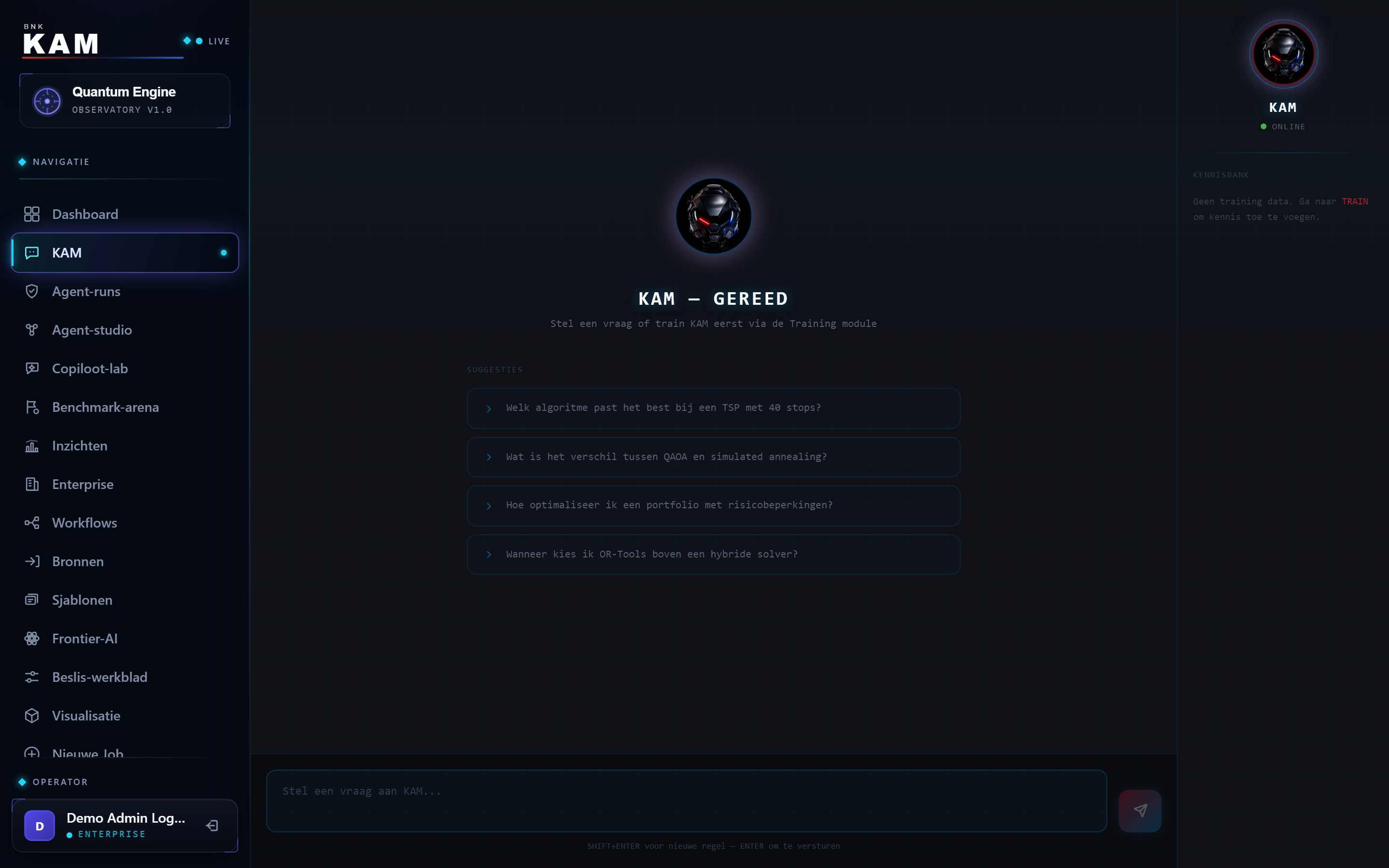
KAM is the platform's built-in AI assistant. KAM answers questions, helps you formulate a problem and connects your question to the platform's real data and tools: jobs, optimisations, the 36+ problem types. KAM does not merely talk, it acts through genuine platform tool-use on your real data, and combines that with a trained knowledge base in which your own corrections override the base knowledge.
Intake & intent
Reads your question and determines whether it concerns an explanation, a problem formulation or a platform action.
Platform-tool-use
Calls real platform tools: querying jobs, starting optimisations, consulting problem types.
Knowledge-base injection
Adds your trained knowledge to the context; your corrections override the base knowledge.
Reasoning
Combines data and knowledge into a well-founded draft answer.
Verification
Checks the answer against the actual platform data and constraints.
Explanation & sources
Presents the answer with justification and traceability.
Memory
Retains relevant knowledge for future questions, in your own knowledge base.
From question to verified answer
Ask KAM a question about your jobs or a problem, and KAM retrieves the real platform data, reasons, verifies against reality and answers with explanation and sources. Every outcome is explainable and traceable, with human oversight. Trained knowledge and corrections make KAM steadily more accurate for each organisation.
What it gives you: an assistant that does not guess, but acts on your real data and shows it.

Why this is unique
KAM does not merely talk, it acts through genuine platform tool-use on your real data. Trained knowledge and corrections make KAM more accurate for each organisation, and every outcome is explainable and traceable, with human oversight. An assistant, a quality lab and a knowledge network in one.

KAM from the inside
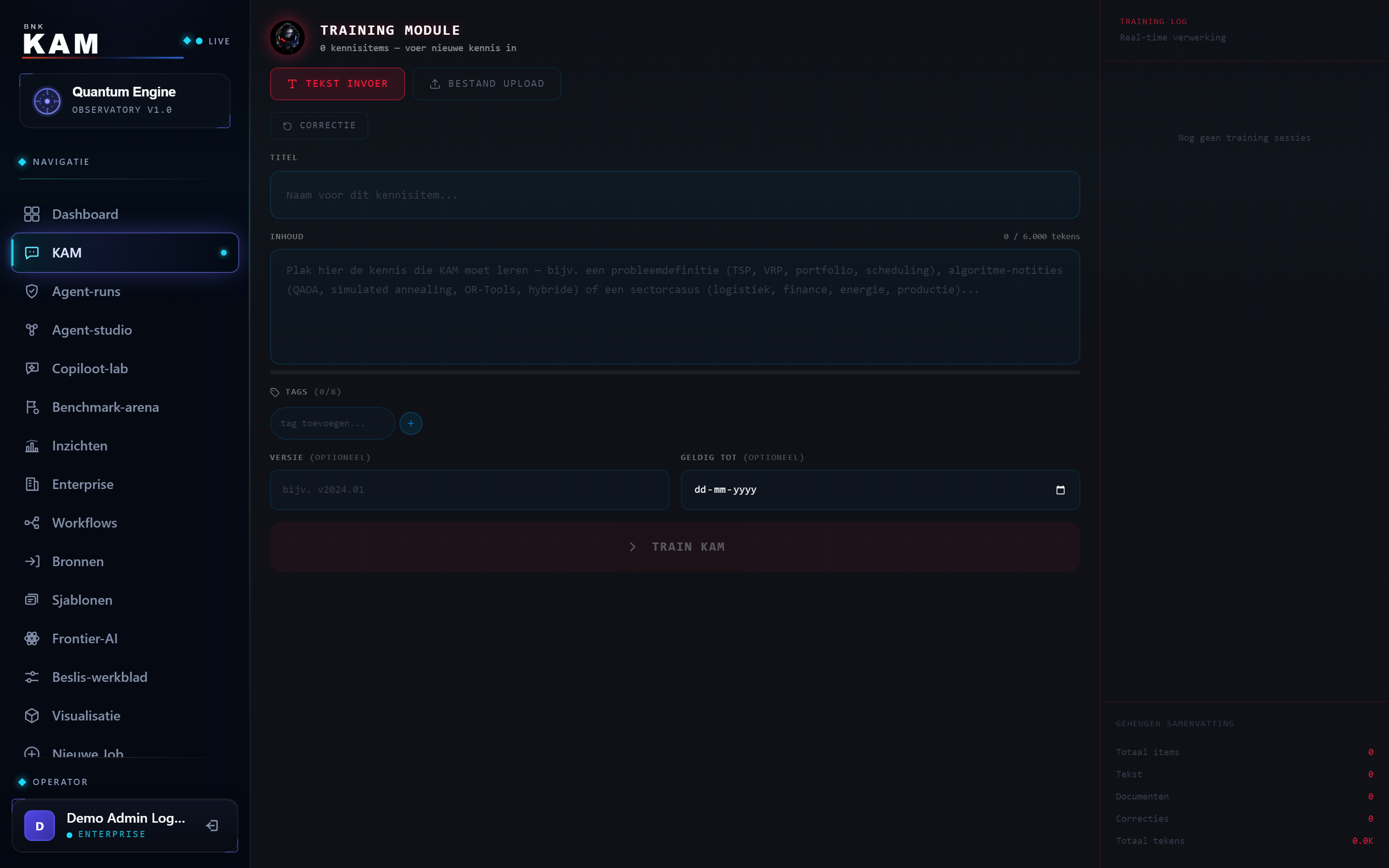
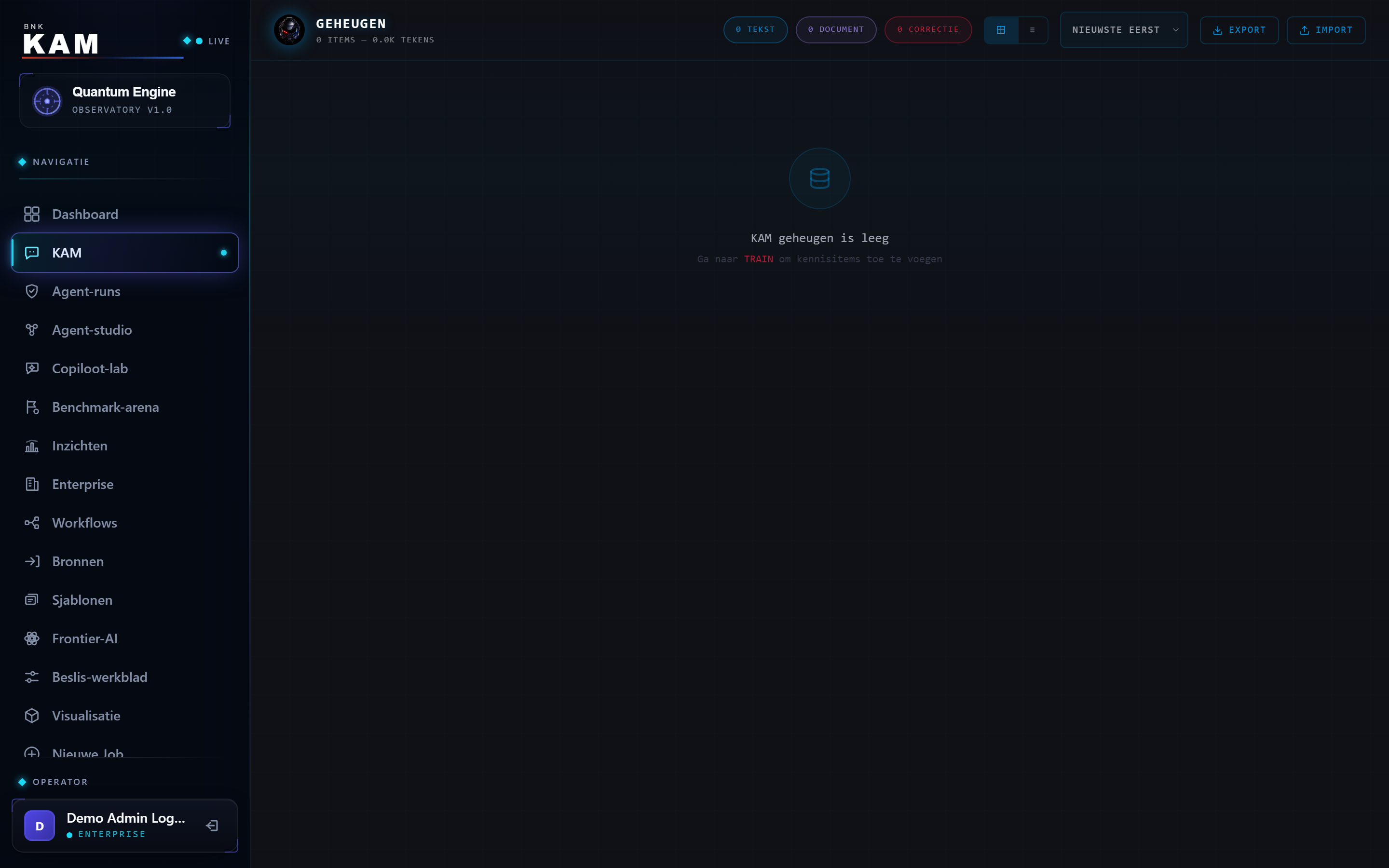
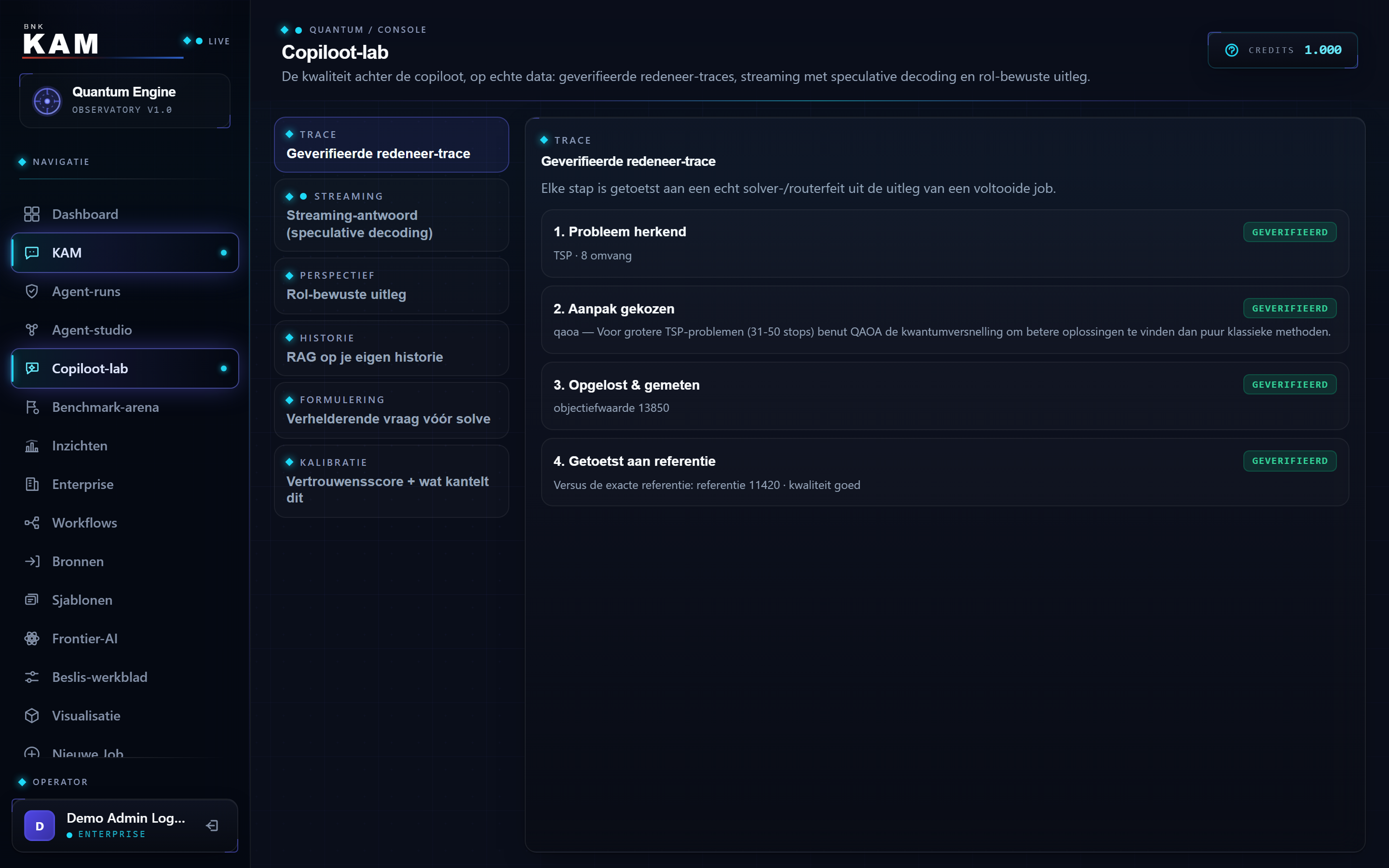
Four tools that together form the co-pilot: a chat that acts on real data, a training module in which your corrections override the base knowledge, a memory that you manage, and a knowledge network that shows the connections. The quality lab safeguards reliability. Swipe through them, or tap a component.

Act IV · The ecosystem, twenty-three modules
Twenty-three modules that feed one another
Intake delivers a problem, the engine computes, the results are visualised and analysed, and KAM connects the whole. The core modules are highlighted below; the full module register with all twenty-three modules appears further down.
Dashboard
The central overview: KPIs, charts, live impact, recent jobs and shortcuts. At a glance you see what is happening and where you can go next.
What it gives you: a grip on your optimisations from the very first screen.

My Jobs, with mandatory explanation
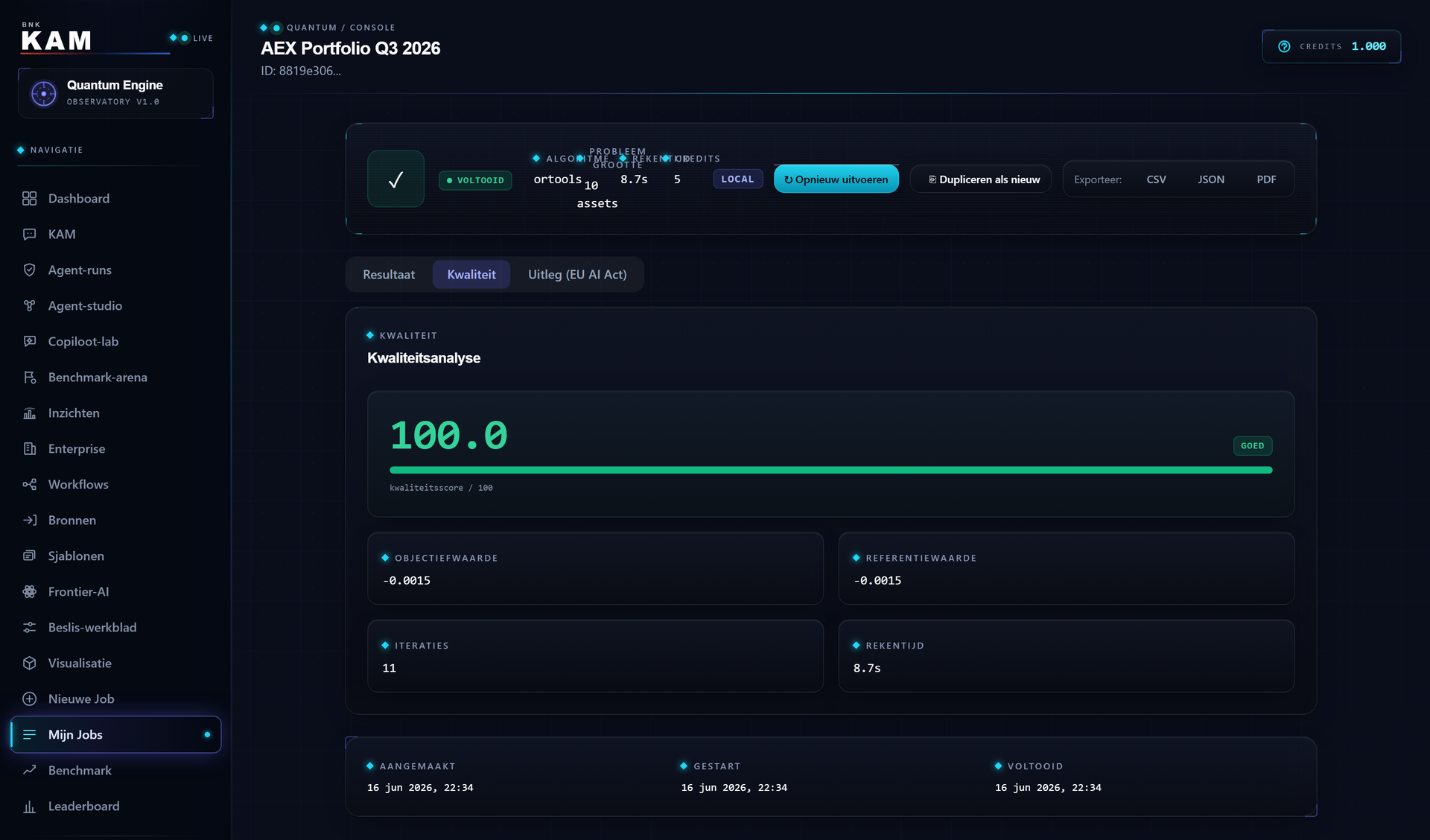
Your central worklist with status and quality per computation, and for each job a detail page with live progress, result visualisation and quality analysis. The Explanation tab is not an extra: it is mandatory under the EU AI Act (art. 13) and describes which algorithm was chosen, why, and with what certainty, including a sustainability block for CO₂ and cost.
What it gives you: every outcome verified, traceable and compliantly recorded.
Swipe through the three tabs of one real, completed computation below, or tap a tab. These are real recordings from the running application.


Visualisation, spatial and on a real solve
Experience a route solution spatially: drag stops on the map and the route re-optimises live, or view that same optimal route as a rotatable 3D scene. Both run on a real solution from the solver, no mock.
What it gives you: intuition for how the solver responds, instead of a table of numbers.

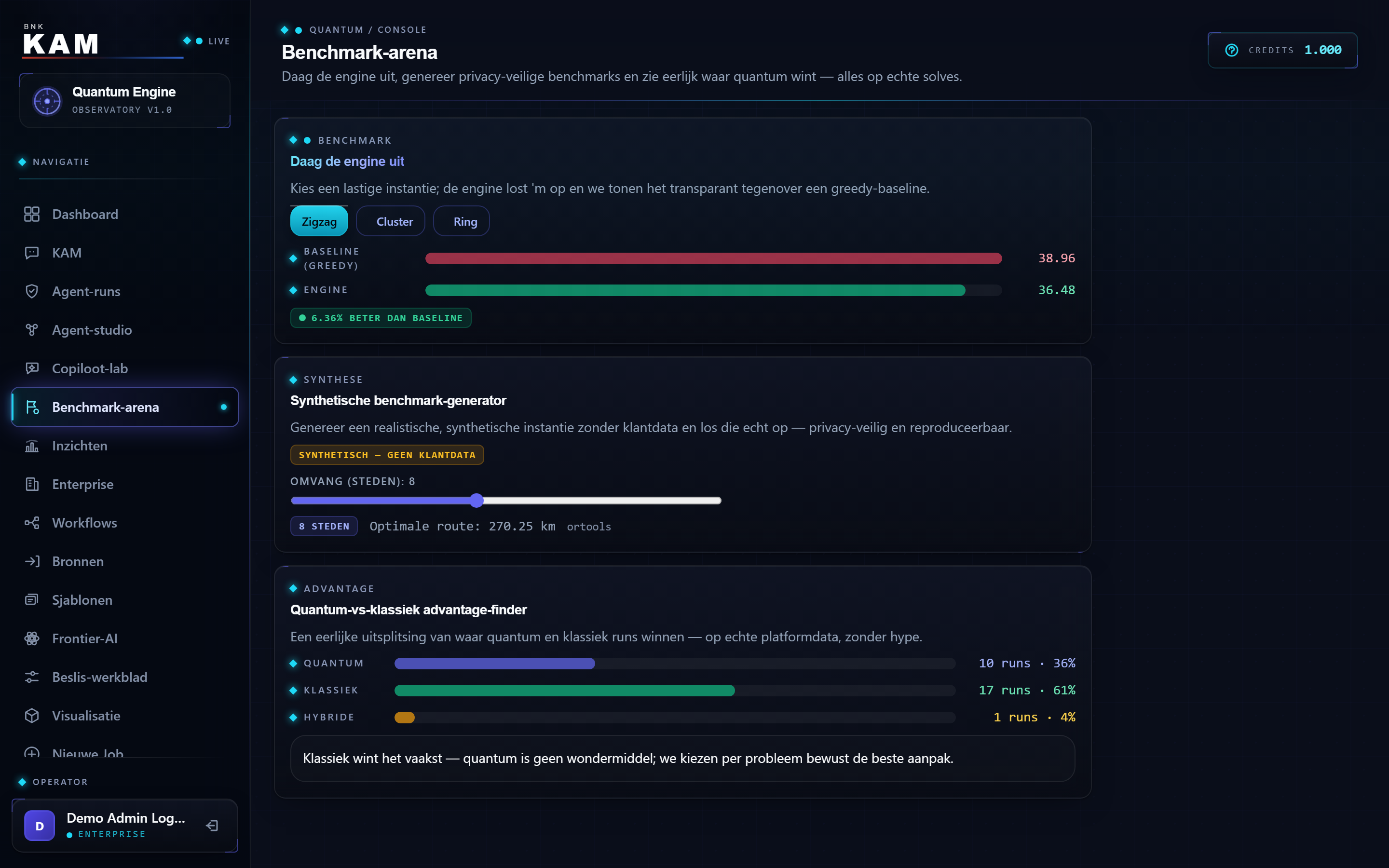
Benchmark arena, the quantum advantage measured
Challenge the engine and measure, on your own problem, how classical and quantum-inspired algorithms compare. Compare algorithms and settings, see the quality and the computation time, and build well-founded confidence in the approach.
What it gives you: proof on your own data, not a promise in a brochure.
Agent runs, supervised and autonomous
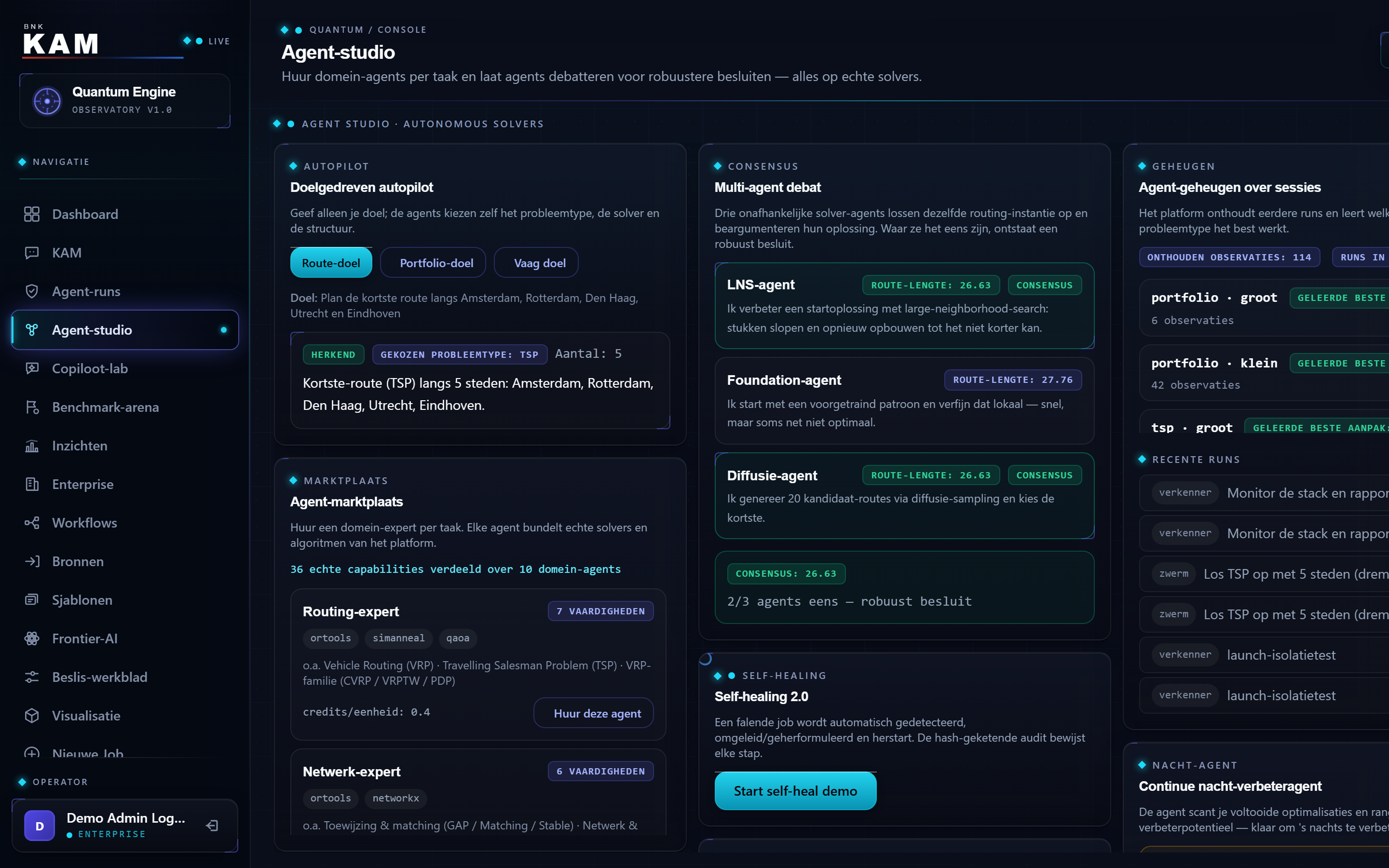
Let specialised agents carry out optimisations within your mandate, with guardrails and a full audit trail. Autonomous where possible, with a human in the loop where required, and everything recorded traceably.
What it gives you: scale without losing control.

Federation and hardware arbitrage
Federated learning lets organisations grow smarter together without sharing a single piece of data. And the hardware module selects, per problem, the best-fitting quantum provider or classical compute core, so you always take the most favourable route to the answer.
What it gives you: learning together while preserving privacy, and the right compute power at the right moment.

Act V · In practice
From a plain-language question to a verified route
Take a routing problem. You describe it in plain language, the engine recognises the type and pre-fills the form, you review and submit, and follow the computation live. As soon as the job is done, the optimal route appears with a quality score, a spatial visualisation and a mandatory explanation dossier. You provide the question and the judgement, the engine provides the justification.
The flow, step by step
1. Describe and interpret
Type your problem into the AI bar. The engine interprets the text, recognises the problem type and proposes parameters. You confirm and the right form pre-fills itself, human in the loop.

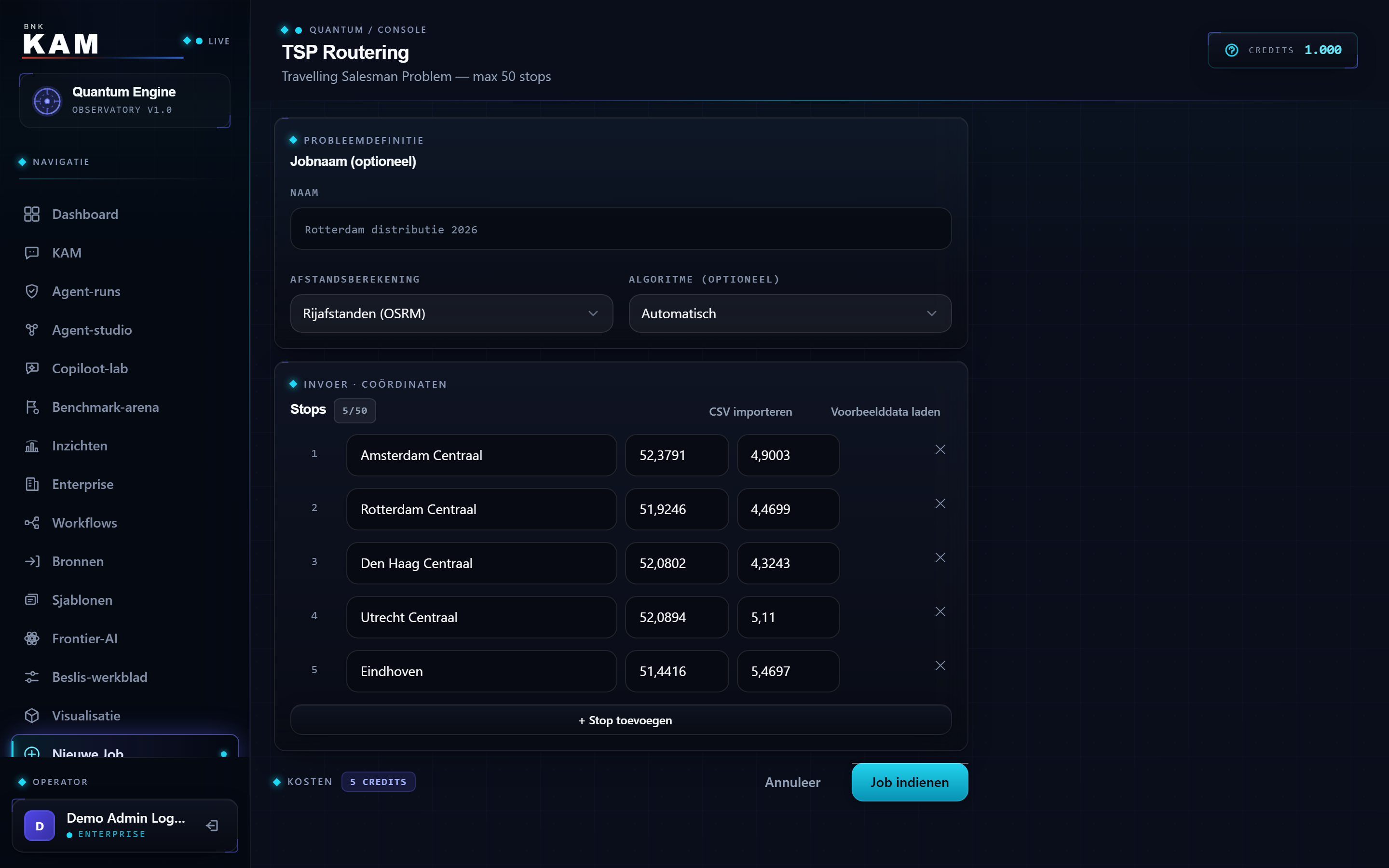
2. Submit and follow live
You review the stops and parameters and submit the job. The computation starts and you follow the progress live, driven by a status ring and a websocket connection, while the hybrid solver determines the optimal route.
3. Review, verify and explain
The result appears with the optimal route, a quality score relative to a reference value, and the mandatory explanation tab: which algorithm, why, with what certainty, plus CO₂ and cost. You export as CSV, JSON or PDF, or download the complete AI Act dossier.

Act VI · Trust & technology
Explainable, supervised and traceable
Every computation delivers a calibrated quality score and, where relevant, an uncertainty band, so you know both how good and how certain a solution is. Autonomous actions have guardrails, an audit trail and a human in the loop. Your data stays yours: federated learning shares insights without sharing data, and enterprise teams get on-prem, budget and quota management and identity and team management.
EU AI Act: transparency and oversight as a designed core
The Quantum Engine is designed with transparency and human oversight as its starting point.
| Art. 13 | Transparency, every job has a mandatory explanation: which algorithm, why and with what certainty. |
| Art. 14 | Human oversight, guardrails and a human in the loop for every autonomous action. |
| Audit & traceability | An audit trail and downloadable dossier (PDF/JSON) per computation. |
| Quality & certainty | Calibrated quality score and, where relevant, an uncertainty band. |
| Data ownership | Federated learning without sharing data; on-prem available for enterprise. |
Why the Quantum Engine, an honest comparison
| Feature | Quantum Engine | Standalone solver | Black-box AI |
|---|---|---|---|
| 36+ problem types, one framework | ✓ Yes | ⚠ Per solver | ✗ No |
| Automatic algorithm choice (router) | ✓ Yes | ✗ Manual | ✗ No |
| Quantum-inspired + classical hybrid | ✓ Yes | ⚠ Varies | ✗ No |
| Calibrated quality score | ✓ Yes | ⚠ Limited | ✗ No |
| Mandatory explanation per outcome (EU AI Act) | ✓ Yes | ✗ No | ✗ No |
| Human oversight, guardrails, audit trail | ✓ Yes | ⚠ Build yourself | ✗ No |
| Intake, computation, visualisation and knowledge in one | ✓ Yes | ✗ No | ✗ No |
| Federated learning without sharing data | ✓ Yes | ✗ No | ✗ No |
Act VII · The complete platform
The complete platform, twenty-three modules
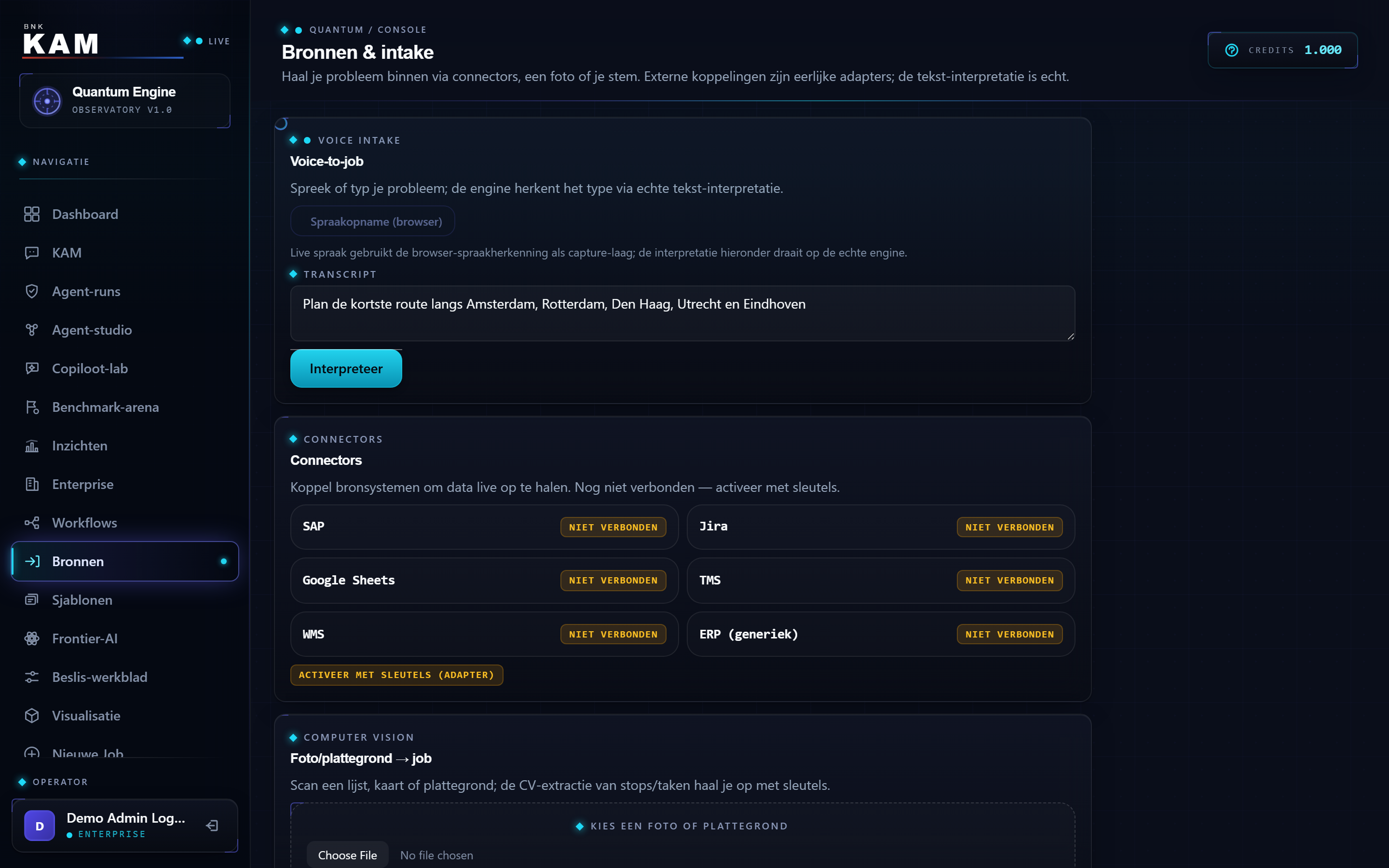
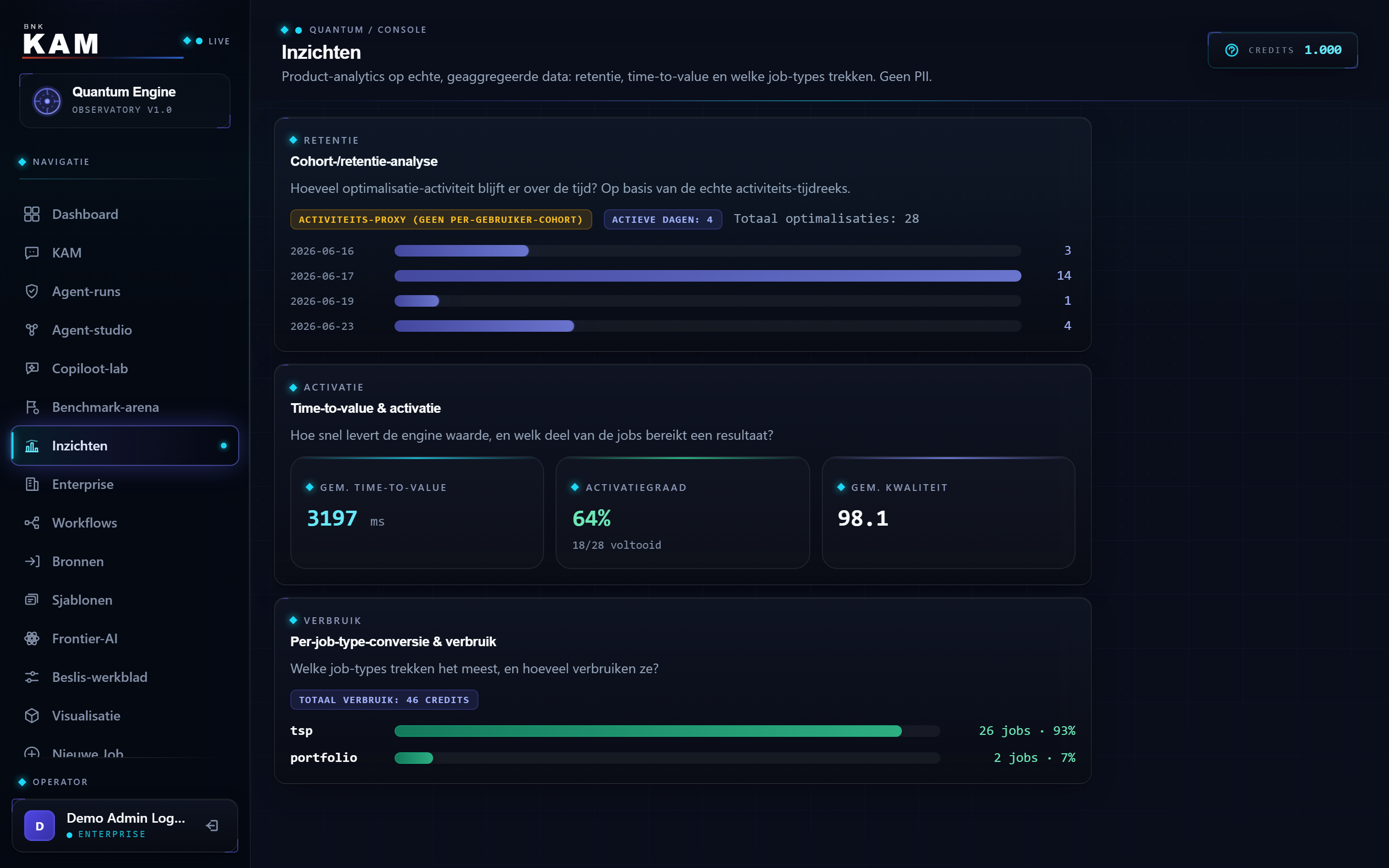
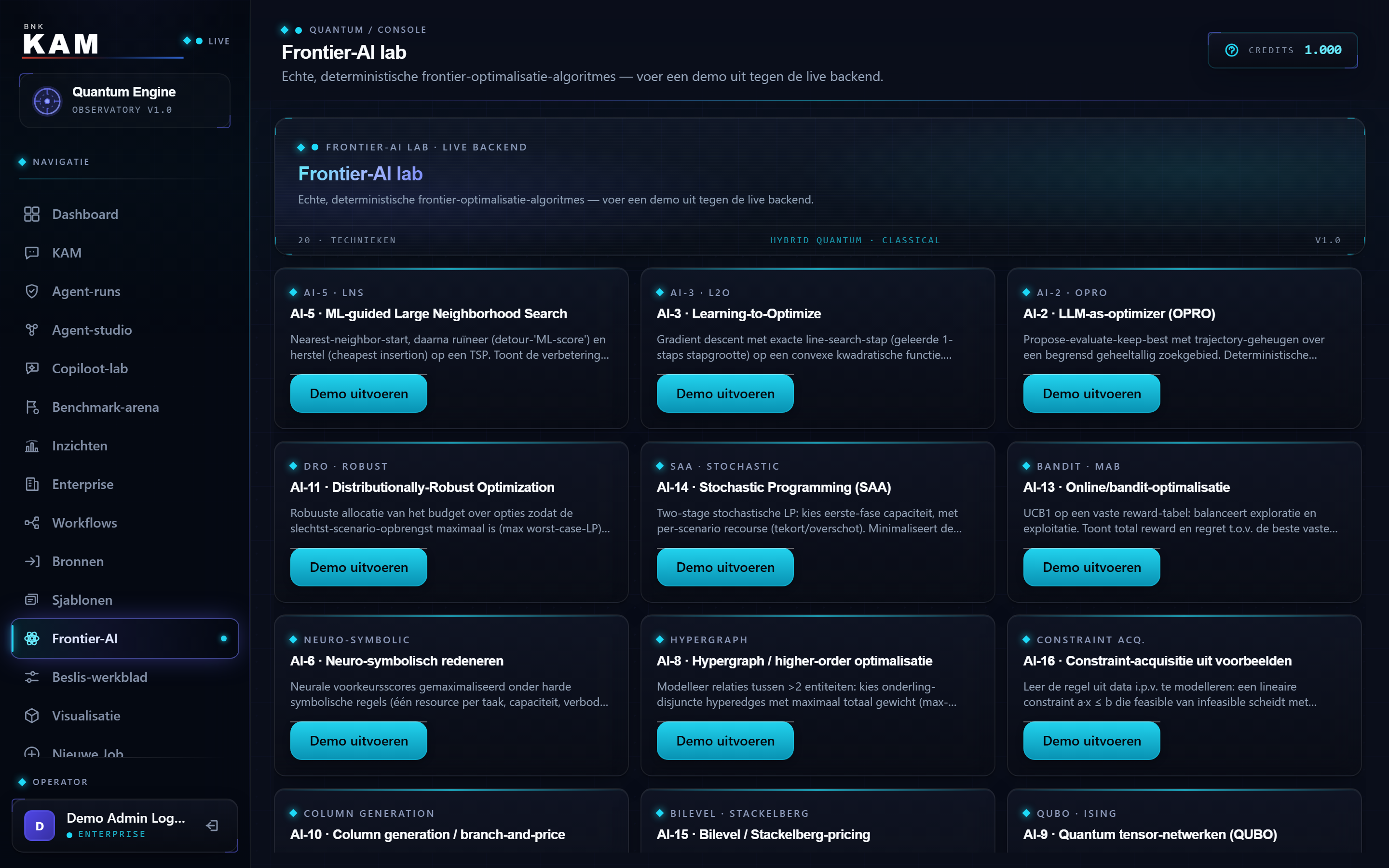
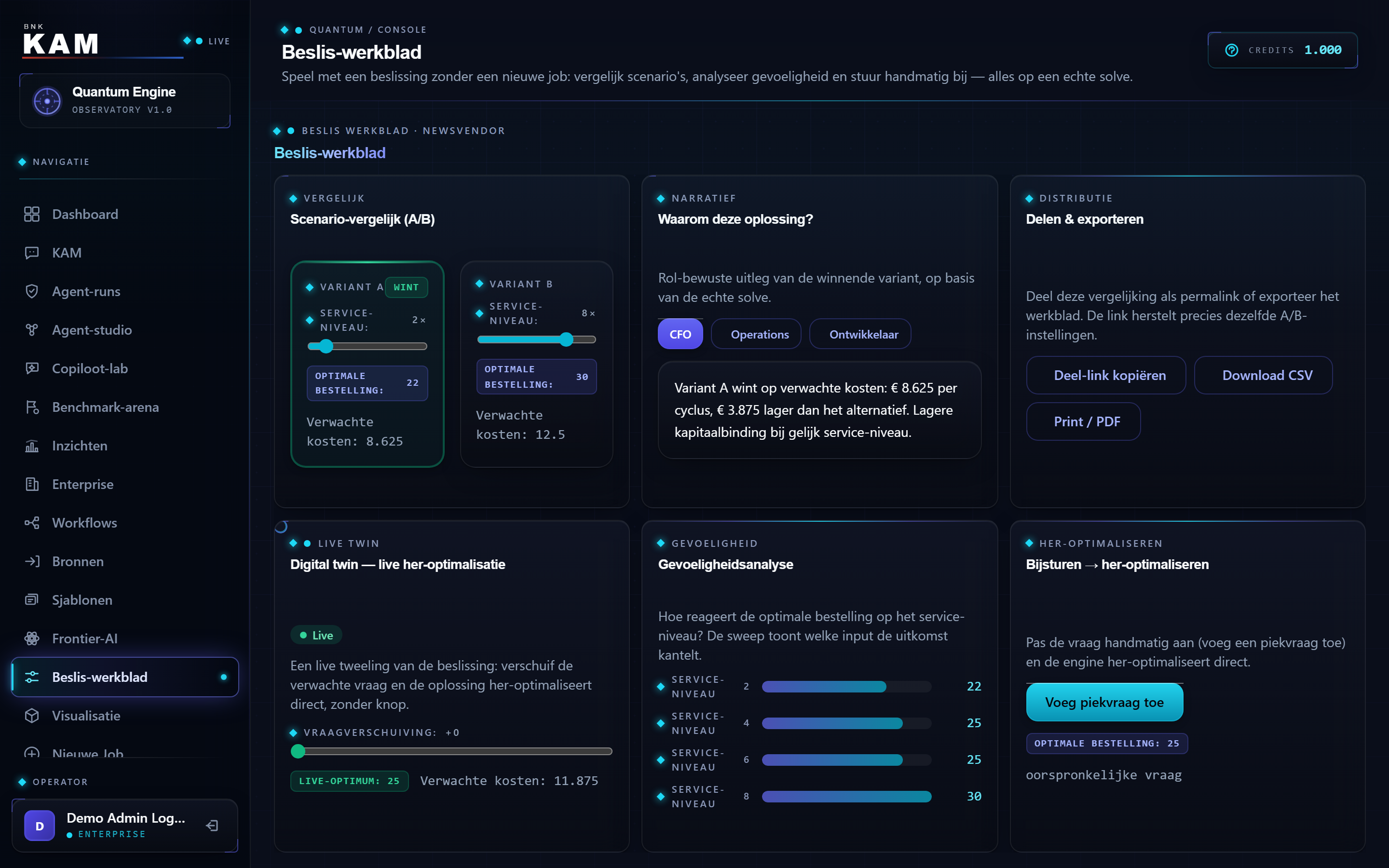
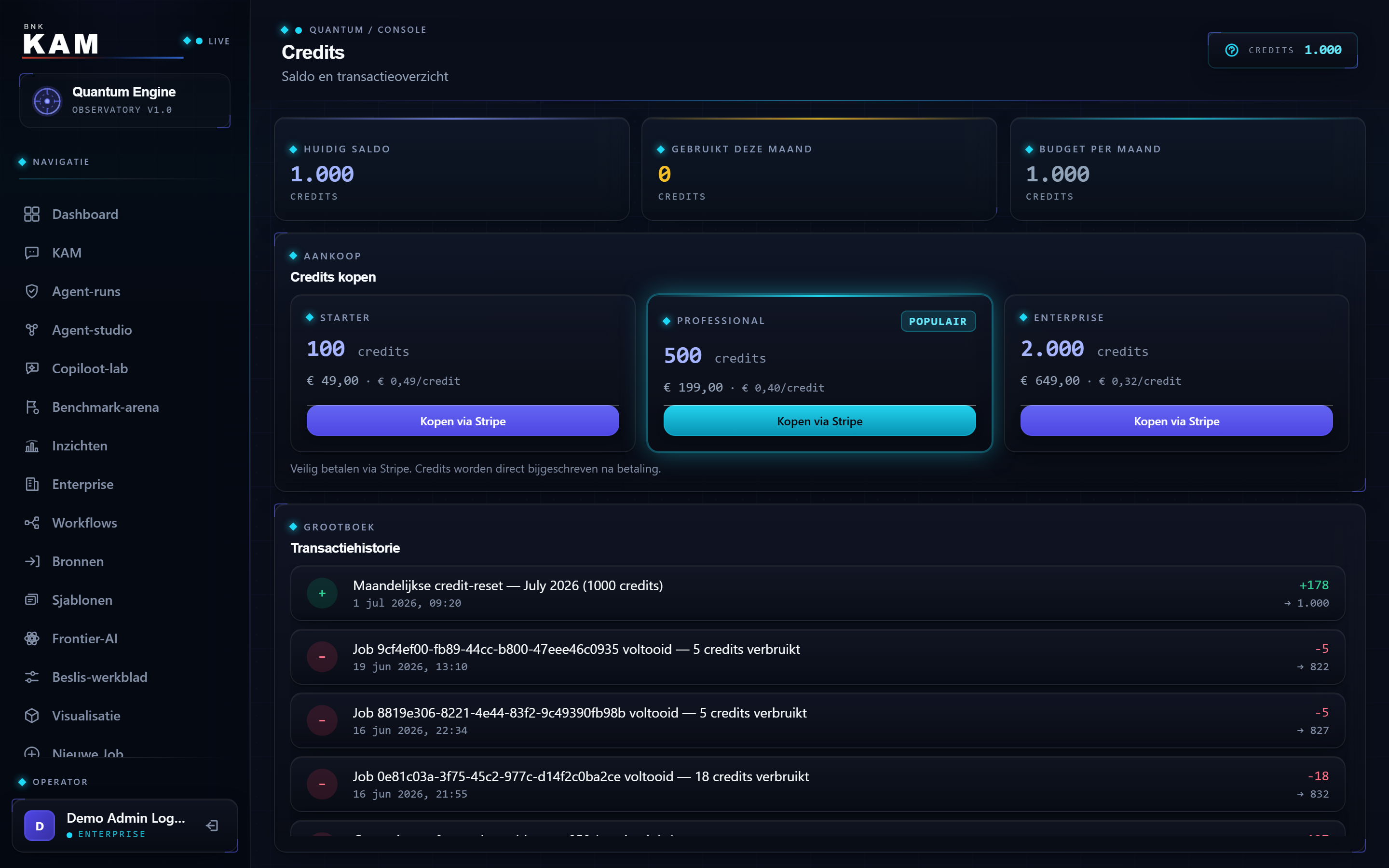
You saw the core modules highlighted above. Below is the wider platform, each remaining module with a real screen from the running application and the story behind it. Intake feeds the engine, the engine computes, the results are visualised and analysed, and KAM connects the whole. Swipe through the modules, or tap one.
Intake & automation


Analysis, management & platform





Who is the Quantum Engine for?
Planners and operations managers who want to optimise routes, rosters and allocations. Analysts and data scientists who need reliable, explainable optimisation without building solvers themselves. Decision-makers who want to know how good and how certain a solution is, with human oversight. And enterprise teams that require guardrails, audit trails, budget management and collaboration.
Frequently asked questions
Do I need a quantum computer?
No. The Quantum Engine is hybrid: it combines classical algorithms with quantum-inspired methods that run on ordinary hardware. Where real quantum hardware adds value, the hardware module automatically selects the best-fitting provider. You need install nothing yourself.
Is it a black box?
No. Every outcome comes with a calibrated quality score and a mandatory explanation: which algorithm was chosen, why, and with what certainty. Autonomous actions have guardrails, an audit trail and a human in the loop. The engine computes and explains, you decide.
Which problems can I solve?
More than thirty-six problem types, including routing (TSP, VRP, Dial-a-Ride), scheduling, assignment, packing, network and graph problems, financial optimisation (Markowitz portfolio), energy and supply chain. Not sure of the type? Describe your problem in plain language and KAM will help you on your way.
What happens to my data?
Your data stays yours. Federated learning lets organisations grow smarter together without sharing data, and for enterprise an on-prem rollout is available, with budget and quota management and identity and team management.
How reliable is a solution?
Alongside the optimal value, the engine shows a calibrated quality score relative to a reference value and, where relevant, an uncertainty band. In the benchmark arena you measure, on your own problem, how algorithms compare.
Ready to find your best decision?
The Quantum Engine is not a promise for the future. It is a working platform that turns your problem into a verified, explainable answer, with you at the helm. We would be glad to show it to you for real, taking your own problem as the starting point.