Medical · AI Tool
Tonyukuk — Medical AI Assistant
More time for the patient. Less time at the keyboard.
An integrated medical AI dashboard for the general practice, built on KAM and the international FHIR R4 care standard. From waiting room to billing, with the doctor always at the helm.
Schedule a demonstrationPlease note: all names, dates of birth and medical data in the screenshots on this page are fictitious and serve purely for illustration. They cannot be traced to real individuals.
Log in · How Tonyukuk begins
Tonyukuk—Medical AI Assistant
Log in
No account yet? Register your practice
This system uses KAM technology to support the care provider. The doctor remains ultimately responsible for every medical decision.
Tonyukuk takes over the administrative routine wherever that can responsibly be done, and lets the doctor do what they were trained for: providing care and deciding.
Capture with speech recognition, an automatically structured SOEP report, underpinned by NHG guidelines, and written into the record after your confirmation. Everything in one environment, on top of the FHIR care standard.
Act I · The problem every GP knows
The paperwork carries on into the evening
A substantial part of the GP’s working day is non-clinical. Consultation reports are typed up after surgery hours, the care provider constantly switches between separate systems for the record, prescriptions, referrals, claims and chronic care, and guidelines have to be looked up and applied by hand. Every hour spent on registration is an hour that does not go to the patient, and a source of workload and staff attrition.
Why existing approaches fall short
Standalone tools solve partial problems but do not talk to one another, so the care provider remains the hub that retypes everything. Generic AI tools give answers without evidence or auditability, unacceptable in a medical context. Many solutions ignore the FHIR care standard, leaving data neither interoperable nor future-proof. And demos often show mock data, they do not prove the system truly works on a real care backend.
That administrative burden comes at the expense of time and attention for the patient. Tonyukuk solves this.
Act II · What Tonyukuk is
One environment for the entire consultation and practice process
Tonyukuk is an integrated medical AI dashboard for the general practice, built on KAM and the international FHIR R4 care standard. It supports the care provider from waiting room to billing, and keeps the doctor at the helm throughout. Tonyukuk is emphatically not a replacement for the doctor and makes no independent diagnoses.
What it gives you: everything around the patient in one place, moving automatically with your day.

Who is Tonyukuk for?
- GPs, who want to capture the consultation faster and in a more structured way.
- Practice nurses, POH-S and POH-GGZ, for chronic care programmes, chronic care and mental-health pathways.
- Practice assistants, for the waiting room, triage, prescriptions, referrals and communication.
- Practice managers, for claims, quality reporting and population management.
What Tonyukuk is not
- Not a replacement for the doctor. Tonyukuk strengthens, you decide.
- No independent diagnoses. KAM suggests, the doctor makes the diagnosis.
- No black box and no autonomous decision-making. Every AI suggestion is evidence-based and auditable, nothing enters the record without your confirmation.
- No mock data. Tonyukuk runs on a real care backend.
Act III · KAM, the heart of Tonyukuk
From consultation to verified record, through one auditable pipeline
Beneath Tonyukuk runs KAM by BNK KAM. Rather than leaving you with a handful of separate tools, KAM brings its capabilities together into one reliable, auditable assistant. It does not process a consultation in a single opaque step, but through an auditable, multi-layered pipeline: each layer adds source evidence or oversight before anything lands in the record, every piece of advice can be traced to a guideline, and nothing is stored without the doctor’s confirmation, after which the report is recorded as a FHIR resource with an audit trail.
Why this is unique
Evidence instead of a black box: every piece of advice can be traced to a guideline and comes with an explanation. Human oversight is built in, not optional: the doctor confirms before anything is recorded. KAM keeps learning through federated learning, without a single patient record leaving the practice. And honest empty states: where no data or external key is yet available, KAM shows this honestly instead of inventing something.
Act IV · The AI automation, in focus
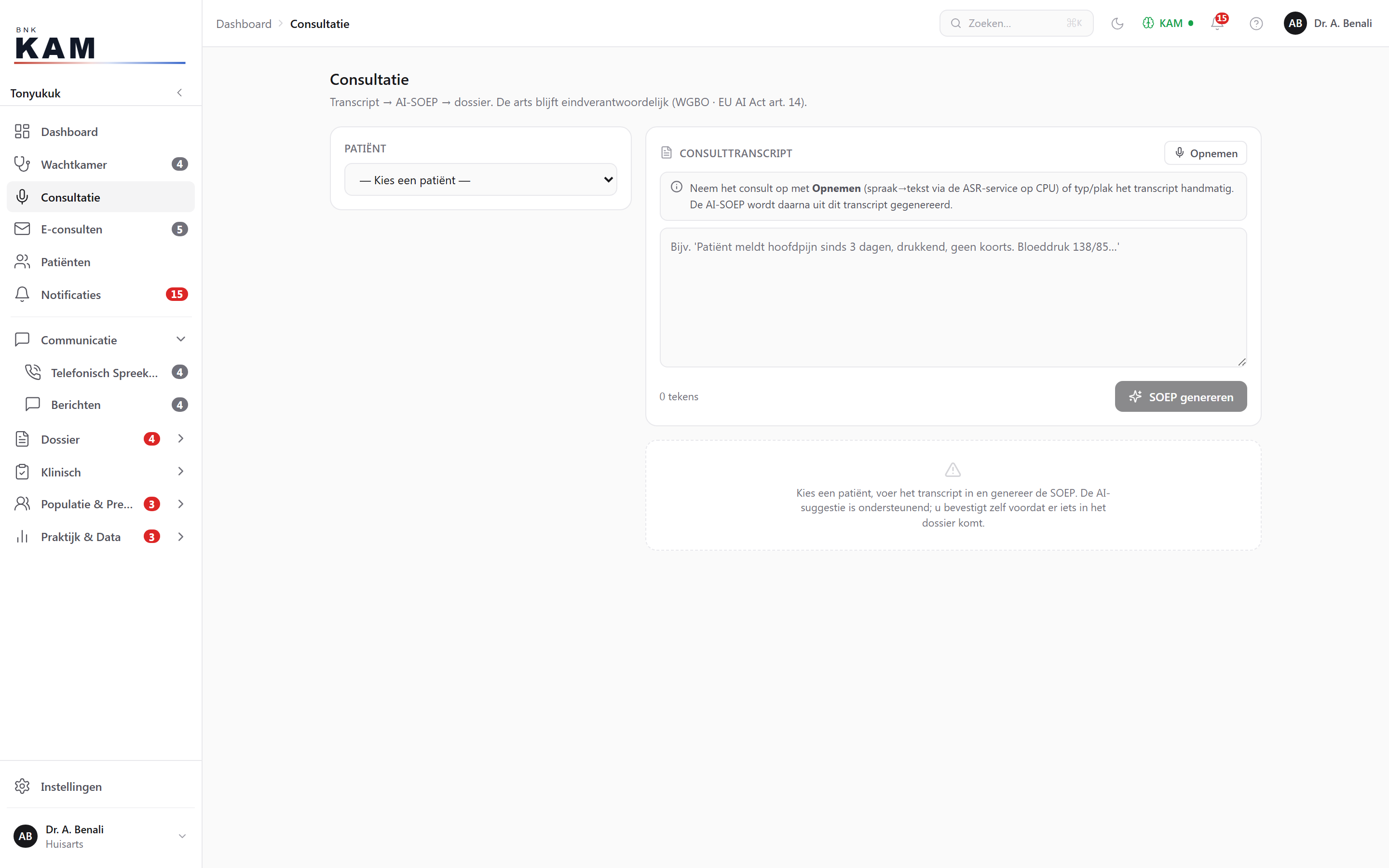
SOEP generation from speech
The doctor records the conversation or types along, and KAM automatically turns it into a structured SOEP report, underpinned by NHG guidelines and provided with a quality score and critical signals. After review the doctor confirms, and only then does it enter the record.
What it gives you: the draft report is ready before the consultation is over, you only need to review and confirm.
KAM Advice, clinical decision support
Ask a clinical question and KAM gives evidence-based decision support drawing on the NHG guidelines and federated learning, with an explanation available for each piece of advice and mandatory human oversight.
What it gives you: the guideline at your side, without looking it up by hand.

The patient letter that stands ready as a draft
Adaptive Patient Communication: from the structured record data of a consultation, KAM automatically drafts a clear draft letter for the patient. In three steps, from patient to send-ready letter. The doctor adds the free text and reviews before sending.
What it gives you: a clear letter for the patient, without a blank page.


Connected Health, the patient between consultations
Vital signs from connected devices, standardised via FHIR Device and Observation, as time series for glucose, blood pressure and heart rate. Deviations lead to a signal for a task or a recall. The signalling is supportive, the care provider reviews and decides on the follow-up.
What it gives you: continuous sight of the chronic patient, the measurement drives the care.

Clinical-trial matching on hard criteria
Tonyukuk matches patients to suitable clinical trials on hard criteria, condition, age and sex, built from FHIR ResearchStudy. On hard criteria, not a loose guess, with clear inclusion and exclusion criteria and transparent evidence for each match. The GP retains the final judgement.
What it gives you: the right patient for the right trial, evidence-based and auditable.

Smart reports, straight from the record
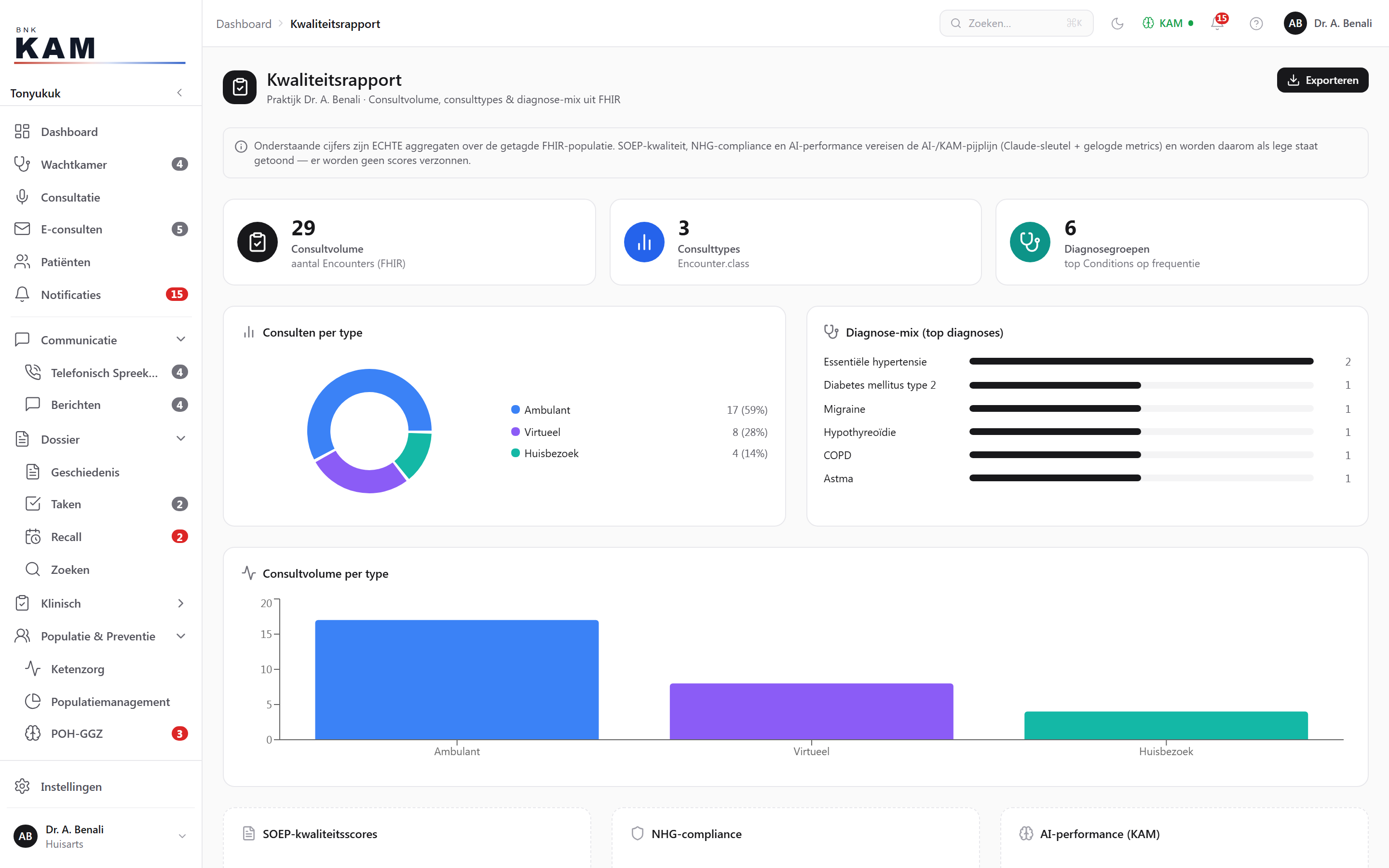
Quality Report and Analytics summarise consultation volume, diagnosis mix and practice quality, and the claim detection points to potentially missed revenue. Everything aggregated from the same record data, without double entry, with transparent empty states while the KAM pipeline is still being activated.
What it gives you: as a practice manager you steer on figures that emerge from the work by themselves.
KAM thinks along everywhere in the platform
KAM is not a separate button but an assistant that thinks along in the right place. Almost every module contains a KAM helper block that offers a suggestion or summary, always supportive, the care provider decides.
| Consultation | Generates the SOEP report from the consultation transcript. |
| KAM Advice | Answers a clinical question with evidence and explanation. |
| Patient letter | Drafts a clear draft letter for the patient from the consultation. |
| E-consultations | Offers a clinical suggestion alongside the patient’s question. |
| Telephone clinic | Triage analysis (NTS) and a draft call report. |
| Messages | Summarises an internal message exchange. |
| POH-GGZ | Helps interpret PHQ-9 and GAD-7 scores within the Stepped Care model. |
| Chronic care programmes | Flags deviations in measurements and treatment goals. |
| Absence | Proposes a reintegration focus. |
| Claims | Points to potentially missed procedures and revenue. |
Every KAM helper block is always supportive, the care provider decides. As long as the language-model key is not connected, the blocks show an honest empty state instead of invented content.
Act V · The whole platform in view
Thirty-five modules, six work areas, one record
Tonyukuk bundles thirty-five modules into six coherent work areas. They share one patient context and one record, so data from one part is automatically available in another.
Core 6
Dashboard, Waiting room, Consultation, E-consultations, Patients, Notifications. The daily hub of the surgery.
Communication 2
Telephone clinic (with NTS triage), Messages. Patient contact captured in a structured way.
Record 4
History, Tasks, Recall, Search. The complete patient record and its follow-up.
Clinical 8
NHG guidelines, KAM Advice, Prescriptions, Referrals, Lab, Vaccinations, Templates, Patient letter.
Population & Prevention 5
Chronic care programmes, Population management, POH-GGZ, Connected Health, Clinical Trials.
Practice & Data 10
Calendar, Claims, Absence, Home visits, Quality Report, Analytics, AI Centre, EHR integrations, FL monitor, AI Transparency.
Every screen, in the order of your day
You saw the core modules Dashboard, Consultation, KAM Advice, Patient letter and Connected Health highlighted above. Below you walk through the rest of the platform, in the order in which a practice day unfolds, from the first contact in the waiting room to the accountability at the end. Every image comes straight from the running application. Click a screen for an enlarged view.
Your day, part 1
The first contact, from waiting room to telephone
The waiting room that sorts by urgency
Who is in, and who needs attention first? The waiting room shows the triage urgency for each checked-in patient, built from the FHIR Encounter status, so the assistant sees at a glance where the pressure lies. The order follows the care need, not the arrival time.
What it gives you: the emergency stands out at once, no one falls through the cracks.

Telephone triage on NTS urgency, U1 to U5
Every telephone query gets an urgency class according to the Dutch Triage Standard, from U1 life-threatening to U5 advice, retrieved from FHIR. The care provider sees the severity immediately, updates the status and handles the call. The NTS urgency is decision support, the care provider retains full responsibility, in line with EU AI Act art. 13 and 14 and NEN 7510.
What it gives you: the telephone clinic becomes structured and traceable, instead of a notepad.

The e-consultation, from question to evidence-based answer
Asynchronous text consultations arrive as FHIR Communication. The doctor opens the question and sees on one screen the patient’s question, the patient’s context, the KAM suggestion block and the answer field. Where the clinical-suggestion source is not yet connected, KAM shows this honestly instead of inventing something, the doctor answers on the basis of the record.
What it gives you: every patient question answered on one screen, with the context alongside, without switching between systems.

Your day, part 2
The record, everything around the patient in one place
The patient register, straight from FHIR
All the practice’s patients in one searchable register, built from the FHIR Patient resource. No separate copy and no double entry, this is the record itself.
What it gives you: one source of truth, always current.

The complete record, diagnoses, medication and care plan
For each patient Tonyukuk bundles diagnoses, medication, measurements and the care plan into one overview, composed from FHIR Condition, MedicationStatement, Observation and CarePlan. Everything you need for the consultation, without searching.
What it gives you: the whole story of the patient on one screen.

The record from within
One FHIR record, ten tabs that feed one another
The Overview you saw above is the aggregation layer of ten tabs. What you open is not a collection of separate screens but one FHIR record: each tab is a different view of the same patient data, so a change in one tab is immediately visible in another. This is how the tabs talk to one another, while you, as doctor or practice nurse, remain in charge of every clinical decision, with human oversight in line with EU AI Act article 14 and the WGBO.
How the tabs hang together
The Overview is the aggregation layer: it automatically brings together your primary diagnosis, the latest consultation, the active medication and the recent measurements. The tabs are not ten separate lists but different views onto the same source, and they feed one another, so what you record in one place appears wherever it is clinically relevant. That is what keeps the record one coherent whole instead of ten separate lists.

Diagnoses Condition
The complete, coded problem list. The diagnosis you record here automatically drives the care plan, the chronic care programme and the overview.

Medication MedicationRequest
Active and completed medication in one overview, with the clinical context to prescribe safely.

Laboratory Observation
All lab values and measurements in a row, linked to the diagnosis they underpin and the care goal they safeguard. Questionnaires such as PHQ-9 and GAD-7 are deliberately kept separate.

Consultations Encounter
The complete contact history as a timeline. Each consultation feeds the report, the diagnosis, the prescription and the lab request.

Documents DocumentReference
The SOEP consultation reports, final only after you, as the doctor, have confirmed them. Unconfirmed text never appears here.

Care plan CarePlan
The ongoing care pathways with measurable goals and current status, automatically updated by new lab values.
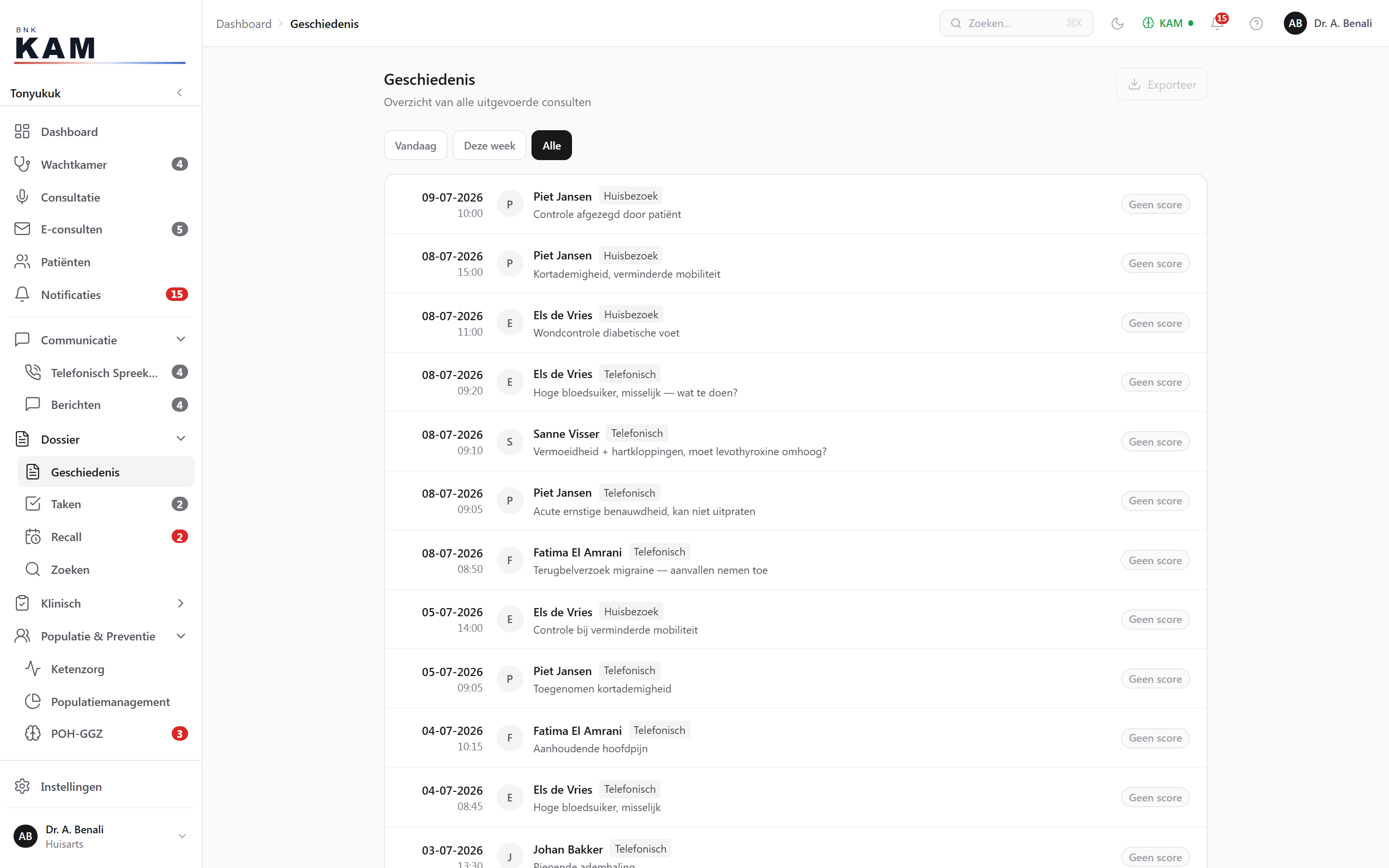
The consultation history as a timeline
Every consultation, in surgery, by telephone or a home visit, lands in a chronological timeline, aggregated from the record. You see the course at a glance, without leafing through separate notes.
What it gives you: the patient’s course in a single glance.
Your day, part 3
Clinical action, from prescription to lab
Prescriptions with ATC coding, from the record
Prescribing happens on the basis of the real medication overview, with ATC codes and a status overview for each prescription, built as FHIR MedicationRequest. Everything traceable, nothing loose.
What it gives you: prescribing with overview, no loose notes.

The referral, created in a few fields
You create a referral to secondary care with patient, specialty, indication and urgency, stored as FHIR ServiceRequest. Automatic letter generation follows once it is connected to the practice, until then the system reports this honestly instead of inventing a draft.


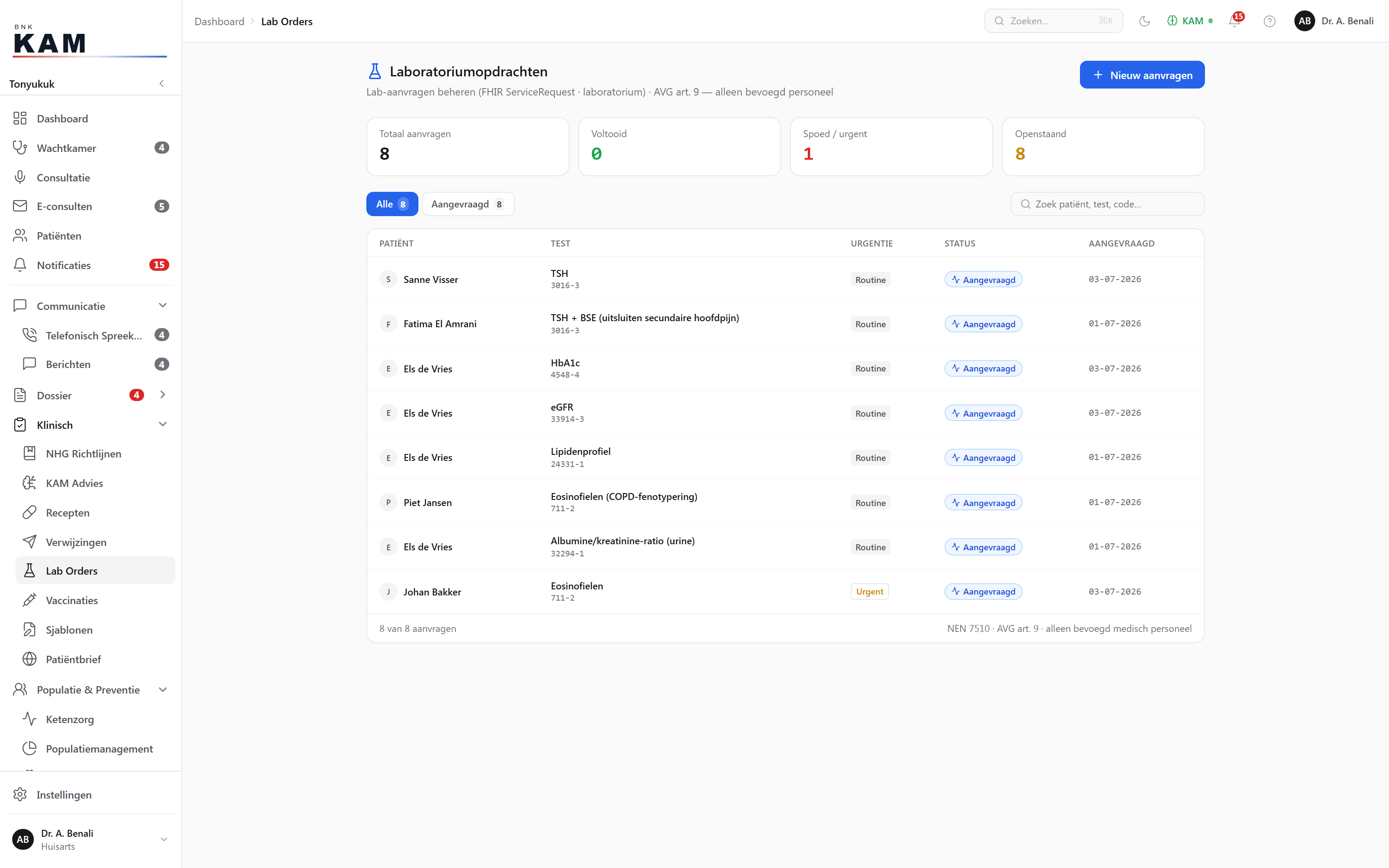
Lab requests on LOINC, with an AVG safeguard
Lab requests are recorded as FHIR ServiceRequest with LOINC codes and an urgency, from routine to immediate. Only authorised medical staff can place requests, in line with AVG art. 9 and NEN 7510.

The NHG standards within reach
The NHG standards with ICPC classification and official source reference, so that advice can always be traced to a guideline. No more separate looking-up during the consultation.
What it gives you: the guideline at your side, with its source.

Reusable SOEP templates per ICPC
For recurring complaints you record a SOEP template per ICPC code, built as FHIR Questionnaire. The consultation starts structured, instead of at a blank field.
What it gives you: faster recording, consistent across the whole practice.

Your day, part 4
Chronic care and prevention, the patient between consultations
Chronic care programmes with treatment goals from the care plan
For chronic patients the chronic care programme shows the treatment pathway and the goals, built from FHIR CarePlan. Deviations in measurements and goals are flagged, the care provider reviews and decides on the follow-up.
What it gives you: a grip on the chronic pathway, goal by goal.

POH-GGZ with PHQ-9, GAD-7 and Stepped Care
The POH-GGZ sees, for each patient, the PHQ-9 and GAD-7 scores and the corresponding Stepped Care level, derived from FHIR. Elevated risk is flagged, with references to the relevant NHG standards. The severity classification is decision support, the assessment of suicidality always rests with the doctor, in line with EU AI Act art. 13 and 14 and NEN 7510.
What it gives you: mental-health pathways structured and escalated in time.

Population management, pseudonymised
At practice level, population management shows the care burden and risk groups, always pseudonymised and with strict access, in line with AVG art. 9. Steer on the whole practice, without touching the privacy of the individual patient.
What it gives you: prevention at population level, privacy safeguarded.

Your day, part 5
Practice and accountability, what emerges from the work by itself
The integrated weekly calendar
The practice calendar brings appointments, surgeries and home visits together in one weekly overview, linked to the same patient context as the rest of the platform.
What it gives you: the week in one view, connected to the record.

Tasks and follow-up per patient
Open tasks, recalls and follow-up actions are bundled per patient, so nothing falls away between consultations. Deviations from chronic care and measurements return here as a task.
What it gives you: follow-up that does not depend on your memory.

Claims with NZa codes, and missed revenue flagged
Procedures become claims with the correct NZa performance codes, built as FHIR Claim. KAM also points to potentially missed procedures, so that care delivered is also reimbursed.
What it gives you: as a practice manager you leave no revenue on the table.

Analytics on consultations and procedures
Consultation volume, diagnosis mix and procedures are summarised into readable analytics, straight from the same record data. No double entry, no separate reporting tool.
What it gives you: management information that emerges from the work by itself.

Connects to your EHR via SMART-on-FHIR
Tonyukuk connects to existing systems via SMART-on-FHIR, with integrations to HiX, Medicom, Nexus, Zorgmail and the LSP among others. It lands in your practice, alongside what you already use.
What it gives you: not an island, but a layer on top of your existing EHR.

All data in the screenshots, names, dates of birth and medical details, are fictitious and serve purely for illustration. They cannot be traced to real individuals.
Act VI · Tonyukuk in practice
Everything connected, around the same patient
In Tonyukuk nothing stands alone. Each module feeds the next, around the same patient and the same record. Three core pathways show that coherence.
From waiting room to recorded consultation
- Check in. The patient reports in, the waiting room shows who is there with the triage urgency per patient.
- Consultation & SOEP. The doctor opens the consultation, records the conversation (speech-to-text) or types along, and lets KAM turn it into a SOEP concept. After review the doctor confirms, in line with the WGBO.
- Follow-up actions. Directly from the consultation follow a prescription, referral or lab order, linked to the same patient.
Result: the consultation is in the history and automatically feeds claims, analytics and the quality report, without retyping anything.
Chronic care, from home measurement to action
- Measure. Wearables send vital signs through, Connected Health shows the time series per patient (glucose, blood pressure, heart rate).
- Oversee. In the chronic care programme the care provider sees the treatment pathway and the goals of the chronic patient.
- Follow up. Deviations lead to a task or a recall, so the patient is proactively followed up between consultations.
Result: continuous sight of the chronic patient, the measurement drives the care, not the other way around.
From consultation to insight and accountability
- Record. Every consultation, in surgery, by telephone or a home visit, lands in the history.
- Bill. Procedures become claims with the correct NZa performance codes.
- Analyse. Analytics and the quality report summarise consultation volume, diagnosis mix and practice quality, all from the same record data.
Result: accountability and insight emerge by themselves from the work you were already doing.
Act VII · Trust, technology & the EU AI Act
Privacy and security as a designed core
Sessions with HttpOnly and secure cookies, access only for certified healthcare professionals. Security headers at A+ level (CSP, HSTS, X-Frame-Options and more). Consultation transcripts are not logged as plain text, hashes are kept. Demonstration data is tagged and isolated from real data. Information security in line with NEN 7510 and a NEN 7513 audit trail of every action. The AVG rights of data subjects and a complaints route are built in and can be found in the AI Transparency module.
EU AI Act, high-risk, transparency and oversight as a designed core
Tonyukuk is classified as a high-risk AI system in a medical context under the EU AI Act 2024/1689. BNK KAM is the provider. Transparency and human oversight are not an afterthought but a designed core.
| Art. 13 | Transparency, explanation available for each piece of advice, and honest empty states where data or a key is missing. |
| Art. 14 | Human oversight, the doctor confirms every AI SOEP before it is stored (WGBO too). |
| Art. 15 | Accuracy and robustness, quality scores and critical signals. |
| AVG art. 9 | Special categories of personal data, pseudonymised aggregates and strict access. |
| NEN 7510 / 7513 | Information security in line with NEN 7510 and a NEN 7513 audit trail of every action. |
How the introduction works
1. Tailored demonstration
We show Tonyukuk for real, with your own way of working as the starting point. Without obligation, around thirty minutes.
2. EHR exploration
Together we explore the connection to your EHR via SMART-on-FHIR, so you know how it lands in your practice.
3. Responsible deployment
A conversation about safe, responsible deployment of AI in your practice, with the doctor always at the helm.
Frequently asked questions
Does Tonyukuk replace the doctor or make diagnoses itself?
No. Tonyukuk is supportive and makes no independent diagnoses. KAM suggests, the doctor decides and remains ultimately responsible. Nothing enters the record without your confirmation, in line with the WGBO and EU AI Act art. 14.
What if the AI SOEP is wrong?
You review and correct every line before you confirm. KAM adds a quality score and critical signals that require attention, and every piece of advice is traceable to an NHG guideline. Without your confirmation nothing is stored.
Does Tonyukuk work with my EHR?
Yes. Tonyukuk connects to existing systems via SMART-on-FHIR, with integrations to HiX, Medicom, Nexus, PALGA, Zorgmail and the LSP among others. We explore the connection together during the introduction.
What about privacy and the AVG?
Access only for certified healthcare professionals, security headers at A+ level, consultation transcripts are not logged as plain text, and a NEN 7513 audit trail records every action. You will find the AVG rights of data subjects and the complaints route in the AI Transparency module.
Which practices is Tonyukuk suited to?
For GPs, practice nurses (POH-S and POH-GGZ), practice assistants and practice managers. From solo practice to group practice, everyone works in the same record from their own role.
What does Tonyukuk cost?
We tailor the price to your practice, which we discuss in the demonstration. That way you pay for what fits your size and way of working.
The next step
Tonyukuk is designed to strengthen the care provider, not to replace them. The doctor decides, Tonyukuk makes that faster, better evidenced and better recorded. We would be glad to show it to you for real, tailored to your own way of working, including an exploration of the connection to your EHR via SMART-on-FHIR.
More time for the patient, less time at the keyboard
A tailored demonstration, with your own way of working as the starting point, and a conversation about safe, responsible deployment of AI in your practice.
Without obligation, around thirty minutes, and fully tailored to your practice.